

FOR THE BEST EXPERIENCE, IT’S RECOMMENDED THAT YOU READ THIS POST ON A COMPUTER MONITOR
As a kid growing up in the middle of nowhere in the middle of the country, hip-hop culture was only ever something I saw on TV and in the movies. No one in my small, rural town was rocking shell-toe Adidas, gold chains, and Kangol caps. That being said, what I was seeing on TV was very exciting to me, so I became semi-obsessed with it in the early 1980s, especially one of the Four Pillars of hip-hop culture, breakdancing (the other three pillars are: Rapping, DJing, and Graffiti).
I don’t remember the first time I saw breakdancing, but I do know it was around 1982, shortly after the now-legendary battle between the Rock Steady Crew and Dynamic Rockers at the Lincoln Center in New York City that took place on August 15, 1981. Although breaking had been around for nearly a decade by that point, the Lincoln Center battle was the first time it gained worldwide exposure thanks to stories from ABC News, The New York Times, and the BBC. After that, it seemed like breakdancing was always being featured on TV and in the movies, most notably the seminal hip-hop films, Wild Style, Beat Street, Breakin’, Breakin’ 2: Electric Boogaloo, and Krush Groove.

Breakin’ Bad
I was never a good dancer, let alone breakdancer, but that didn’t mean I didn’t give it a shot. At home in my living room, I’d try to replicate “toprock” moves – stuff you do while standing up, like The Robot and The Wave (though I don’t think it was actually called that, but you know what I’m talking about, don’t you?)
It was at school, of all places, that I worked on my “downrock” moves – things like the 6-step and the backspin would be prime examples. I remember my fourth grade class in 1984 was able to play music at indoor recess during the cold winter months and one of my friends brought in a cassette tape of breakdancing music he’d gotten from his older brother. For about a month every day after lunch, this awkward group of white kids would try to bust out our best moves, flailing and failing miserably. But we had a ton of fun and the floor burns to prove it. By the Spring of ‘85, when we could go outside again, the fad had died off and my days as a breaker had ended. It was probably for the best.
My Hip-Hop Journey
But this brief fascination with breakdancing would help spark my interest in the culture a few years later. I’d gotten swept up in the 1950s nostalgia wave of the mid-80s thanks to Back to the Future, then moved on to hair metal in ‘87 with Guns N’ Roses Appetite for Destruction and, especially, Def Leppard’s Hysteria. But NWA’s Straight Outta Compton hit me like a ton of bricks in 1989, and I was hooked on hip-hop for about a decade.
I still listen to some of the formative albums that came out in the 90s from groups like Public Enemy, A Tribe Called Quest, Ice Cube, and Dr. Dre & Snoop Dogg. I also still keep my ear to the genre, especially when names rise above the rest, like Kendrick Lamar, Run the Jewels, or Doechii, but I don’t really keep up with everything that comes out anymore.

In the last few years, I’ve started collecting vintage hip-hop records, as well as produced a too-long-dormant hip-hop history podcast, Bring the Noise. It’s been really great discovering music that I had zero exposure to back when it was released and learning about artists that I only had a very surface-level knowledge of through cultural osmosis.
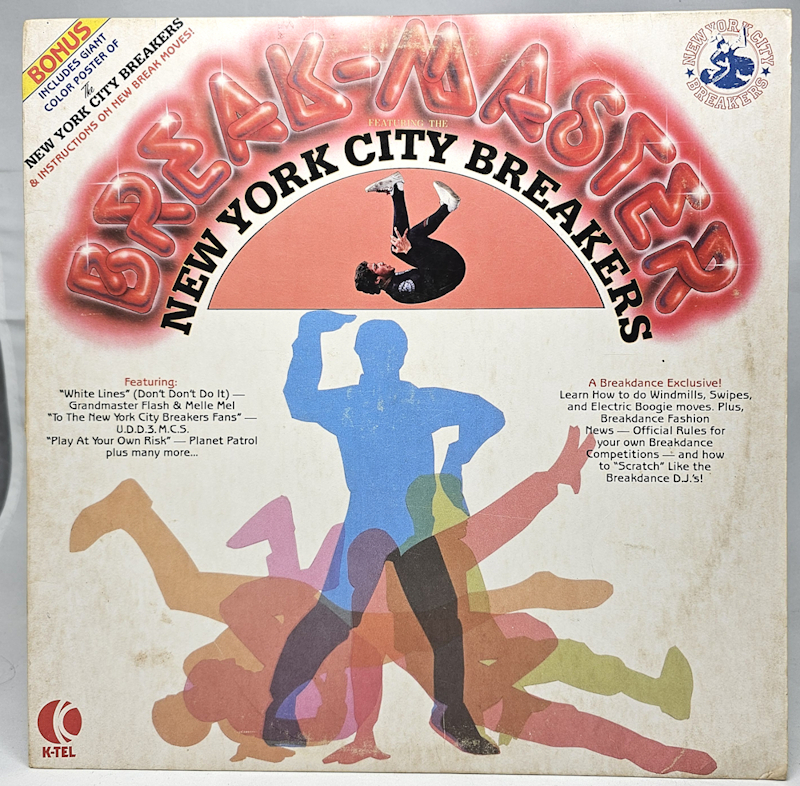
About two years ago, while rummaging through the record crates at an antique mall, I came across a record called Break-Master featuring The New York City Breakers. The record itself wasn’t anything too special – it was mostly a compilation album of early electro hip-hop songs. I loved the early-80s graffiti vibe of the cover art, but what really drew me in was the promise of a poster inside with breakdance move instructions!

Unfortunately, the copy at the antique store did not contain the poster, so I let it pass. But, I added the record to my eBay Saved Search list and kept an eye on it ever since. I was soon to discover that copies of the album with the poster were always way out of my price range – typically anywhere between $35 – $75, plus shipping. But, as the old saying goes, patience is a virtue. A copy recently came up on eBay – with the poster – for $20 with shipping. I figured, for that price, I couldn’t pass it up. And, man, was it worth the wait.
The New York City Breakers
But let’s back up for a minute and talk a little bit about The New York City Breakers and the man who brought them together, Michael Holman.

Holman was an artist, filmmaker, and entrepreneur that was floating around the New York hip-hop scene in the late-1970s and early-80s. He hooked up with influential early hip-hop ambassador, Fab 5 Freddy, and helped break hip-hop out of The Bronx and into Manhattan with live shows at nightclubs like The Ritz, Tier 3, and The Mudd Club. The New York City Breakers were a kind of supergroup boy band of breakers that Holman put together to perform at Negril, a nightclub that was one of the first outside of The Bronx to have a regular hip-hop show. The original Breakers were made up of eight members, mostly pulled away from the Floor Master Crew, a troupe that had been established a few years earlier in The Bronx.
Dancers would leave and others would be added over the years, but the members during the crew’s heyday were:


Shortly after forming in May 1983, the Breakers performed for a national audience on The Merv Griffin Show in June, and then performed at the Kennedy Center Honors, along with members of another crew, The Dynamic Rockers, that same year.
But 1984 was the real breakout year for the crew, battling the Rock Steady Crew in the film Beat Street, being featured on the primetime show Real People, performing on Good Morning America and Soul Train, and were one of the key acts on the short-lived Graffiti Rock, a hip-hop American Bandstand TV show produced and hosted by Holman.
In January 1985, the crew was invited to perform at Ronald Reagan’s Inaugural Gala.
They would also become one of the first crews to go international, performing for English and Norwegian royalty.
Breakdance Decline
By about 1986, the country’s fascination with breakdancing – and to some extent, the first wave of mainstream hip-hop – was dying down. The last hip-hop movies of that era were released in 1985 and seeing teenagers spinning on their heads and popping-and-locking became fairly passé. Of course breakdancing never went away as a form of expression, most famously making its way into competition at the 2024 Summer Olympics…with questionable, but meme-able results.

As for The New York City Breakers, I couldn’t find anything definitive, but it would appear that they have since broken up as a crew. As the interest in breakdancing waned, I’m sure the gigs dried up. I’m also sure that some of the members aged out, probably got busy with family life, and wanted to pursue other interests as well. But they had their moment in the spotlight and made an impact on the dance world, as well as hip-hop culture.
The Record
Break-Master was released by K-Tel Records in 1984 at the height of The New York City Breakers’ popularity. K-Tel is such a wonderfully bizarre company who had their hands in so many different types of businesses. Founded in 1962 by Philip Kives from Saskatchewan, Kives was, for all intents and purposes, the inventor of the infomercial. He started by selling Teflon-coated frying pans, but his empire would eventually sell hundreds of handy-dandy gadgets like the Veg-O-Matic, the BeDazzler, the Miracle Brush, and the Record Selector.

In 1966, Kives began hawking music compilation albums, another thing he essentially invented, starting with 25 Country Hits, before moving on to 25 Polka Greats.
At first, record companies were reluctant to let their music appear on another label’s product, but they eventually saw that these albums were a new revenue stream for songs whose sales had dried up. Compilation albums became the mixtapes of the day and soon just about every record label was dusting off old music to throw together on a “Best of” record.
But Kives really hit it big with his first compilation of original music in 1981, Hooked on Classics, which featured classical music performed by the Royal Philharmonic Orchestra, just slightly disco-fied with a drum machine. The album was hated by classical music purists, but the public ate it up, peaking at number four on the U.S. Billboard charts and going on to become certified platinum. A number of Hooked on Classics albums were released over the next 20 years with varying themes, as well as diminishing returns, but it helped solidify K-Tel’s reputation in the market.
As was K-Tel’s modus operandi, Break-Master is mostly a compilation album of previously-released music from the early electro hip-hop era.
SIDE A
“Play At Your Own Risk” by Planet Patrol
“Space Cowboy” by Jonzun Crew
“Sucker MCs” by Run-DMC
“The Dark Side” by Zero Hour
SIDE B
“White Horse” by Laid Back
“Freak-A-Zoid” by Midnight Star
“Body Talk” by The Deele
“Vocabulary Rock” by Michael Holman & UDD 3 M.C.s
“White Lines (Don’t Do It)” by Grandmaster Flash & Melle Mel
“To The New York City Breakers Fans” by UDD 3 M.C.s & Derek Vargas
I created a YouTube playlist of the songs in the order they appear if you want to check it out:
For the most part, all of these songs seem like they would have been blasting from a young B-Boy/B-Girl’s boombox in 1984. Well, except for maybe “White Horse” by the Danish group, Laid Back. That one just seems too, well, laid back to really inspire someone to spin on their head. But I was a white boy from the flat plain farmlands of Illinois in 1984, so what do I know?
A majority of the artists featured on the album were pretty well-established. But the UDD 3 M.C.s’ only credit that I can find is the Break-Master album, so I have no clue who those guys were. My guess is they were studio musicians who were brought in to perform pre-written lyrics and were never meant to be anything more. Derek Vargas is, apparently, a young boy who wrote a fan letter to the New York City Breakers and got the chance to read it as part of the “Fans” song. “Vocabulary Rap” is a musical dictionary of hip-hop terms, some of which have survived to this day (i.e., Fresh, Whack, Def, Juice, Homeboy), while others seem to be very of-the-time (i.e., Throwing Bass, Nitro, Flaking, Maxing). Holman wrote the lyrics and the UDD 3 M.C.s perform.
The record comes wrapped in a full-color sleeve with some simply amazing mid-80s pop culture on both sides.

One side features completely forgotten video games for the Commodore 64, VIC-20, Apple II, and Atari computers from K-Tek Software (I’m telling you, K-Tel had its hands in so many businesses…). Titles include Gower Gulch, Babysitter Vol. 1, Jail Break, Lava Run, LHasa Mountain, Spacial Command Post, Attack of Atlanteans, Undiscovered Galaxy, Lucifer’s Revenge, Prisoner, The Crystal Orb, Plutonium Race, and a rock band simulator, It’s Only Rock ‘N’ Roll (it…does not look fun).

The other side of the sleeve has an ad for Breakdance: You Can Do It! From K-Tel Video (naturally). “Attractively priced” at $30 and available on both VHS and Beta, this tape promised a full hour of breakdance instruction from an expert – Odis Medley, a performer who was pretty hot back in the mid-80s as a dancer on Soul Train, and in the videos for Michael Jackson’s “Moonwalker” and “Smooth Criminal”. The tape also includes “exciting segments” from the major motion picture release, Breakin’. Thankfully, the YouTube channel, Reelblack One, has digitized the complete video and uploaded it for our enjoyment:
The Front of the Poster
But the real star of the show is the poster that was included with this album! It measures about 22” x 36”, so it would have been the highlight of any super def fresh kid’s bedroom in 1984.

Unfortunately, the poster I got off eBay is pretty delicate, especially along the well-worn fold lines. So, I wasn’t able to manhandle it onto my flatbed scanner and get high-quality close-ups of everything. I took some photos with my phone and tried to line things up as well as I could though, so you can at least get a sense of what it offers in the way of breakin’ fun.
The main feature, of course, is a full-color photo of the OG New York City Breakers, complete with their signatures.

Along the bottom is a section intended to be cut off so you can take it with you to the streets or over to your friend’s house. This section has instructional photos and descriptions to help you learn how to do moves like Swipes, Windmills, and the Snake. I’ll post the photos, and rewrite the instructions below each dance move so you can try them for yourself. (Pardon the wonky angles and warped edges of these photos. Again, I was being as delicate as I could with the poster, so it didn’t always lie flat for the photos. And because I had to take these close-up photos in stages, things didn’t always align perfectly. Hey, it’s not like you’re paying for this website or anything!)
SWIPES

1A. Starting position from footwork
2A./3A. With legs bent, feet on the ground and body facing up, whip right shoulder around in the air landing with hands on the ground, left hand first.

4A./5A. While hands and arms support body, legs whip in the air while torso remains parallel to the ground.
6A./7A./8A. Twisting shoulders, whip legs to the ground and twist upper body to face up position with arms in air.

9A./10A. Continue the motion whipping right shoulder over and placing hands to the ground and legs in the air.
FOOTWORK INTO WINDMILLS (NECK MOVES)

1B. Starting footwork position
2B./3B. Lift body in the air supported by arms and hands.

4B./5B. Whip the left shoulder underneath body and roll rapidly across the shoulders onto back with legs extended in the air in a circular motion.
6B. Continue rolling over right shoulder twisting body in a circular motion.

7B. Twist until body is again facing down supported by arms with legs in air.
8B./9B. Continue gyrating motion, rolling from chest supported by hands to the back with legs extended in the air and out from body.
SNAKE (ELECTRIC BOOGIE)
There are no detailed instructions for the Snake. I have a feeling they took the photos and then realized that trying to explain how to do these moves would require a lot more space on the poster than they had available. Instead, there’s just a caption that reads, “Mr. Wave’s incredible snake. Can you bite Mr. Wave’s super fresh move?” Based upon the angles of his ankles and knees, I’m thinking my answer would be, “No. No, I cannot.”


NYCB FAN CLUB & MERCHANDISE FORM
Of course at the bottom of the poster was a form you could fill out to become a literal card-carrying member of The New York City Breakers Fan Club. And any fan of the Breakers would want their own t-shirt with the crew’s logo, right? Man, what I wouldn’t give to have one of those vintage shirts right now…

That being said, I am planning on creating a shirt for myself using the NYCB logo, because it’s really pretty awesome.

You could also order Holman’s book, Breaking & The New York City Breakers, which promised a special chapter on how to breakdance, with 532 photos and illustrations! I wish I had paid $8 for this book then, because now it goes for $45 (although, admittedly, it does look pretty cool and might be worth it to treat myself to a copy some day). I haven’t found any vintage copies of the book online, but here’s a modern day version of the cover:

The Back of the Poster
The back of the poster is mostly blank except for the reverse side of the section with the dance move instructions. There you’ll find a sort of early hip-hop culture primer for those who weren’t down, but wanted to be.
B-BOY HIGH FASHION
First up, is a photo of Tony “Pexster” Lopez wearing the freshest B-Boy clothes money could buy:

VOCABULARY
Next is a short dictionary of hip-hop slang, very similar to the list from the track “Vocabulary Rap” on the album. Instead of a photo, I’ve just recreated it here for you:
Breaknight – noun a night of partying that goes on until the break of dawn
Boom Box – noun a word to describe a portable radio/cassette player
Burner – noun a word that describes a large scale graffiti piece usually done on a subway train
Bust It – verb a word used to get someone’s attention in order to tell them something
Crush – adjective a word used to describe cool, crew fashion
Ex: “Yo Bi, those adidas look crush.”
Cryin – verb the act of laughing
Ex: “Homeboy was so funny he had me cryin’”
Dog – verb to overuse, abuse, spoil through excell
Ex: “He dogged his sneakers. They were all critical looking.”
Fess – verb to be irresponsible. To not live up to obligations.
Ex: “Forget him, he’s always fessing.”
Freeze – noun a Breakdance position which ends a combination
In Check – adjective to be in control
Ex: “I’ve got my moves in check.”
Iced – adjective to be closed out of or kept out of something
Ex: “We had to ice that guy from the crew.”
Old School – noun Breakdance moves from the seventiesQuick Cut – noun D.J. mixing short moments in 2 of the same records
Play or Getting Play – noun to get response from a girl
Run – verb to repeat in excess, to be redundant, to use over and over
Ex: “That song was alright until they started running it.”
Scratch – verb to manipulate records back and forth across the needle creating a ripping noise
Speak On It – verb to talk about something that takes courage
Starvin’ Marvin – noun someone who is poor or dresses bummy
Tag – noun graffiti artists’ name
Take Out – verb to beat in battle
Throwing Bass – verb rapping to girls
Travelling – verb moving out of control in backspins
Yo a New York style of addressing or calling someone
HOW TO BE A QUICK CUTTING-SCRATCHING D.J.
There’s a brief overview of two key elements of early D.J. skills- Quick Cutting (using two turntables, duplicate records, and a mixer to repeat a section of a song, like a sample or a break beat) and Scratching (literally just swiping one of the records back and forth, scratching the needle on the record, preferably to create a beat). I’m not sure how easily it would have been to get the gist of these skills – especially Quick Cutting – from these photos and the description, but maybe it would make more sense to someone who was already familiar with the equipment.

QUICK CUTTING – Quick cutting is an artform invented by Hip Hop D.J.’s used to repeat over and over, a funky part of a record. (This is done by using 2 turntables, a mixer, headphones and two of the exact same records.) The reason for quick cutting was to make the “break” or “bridge” in a record (which was usually the best part of most funk/disco records) last longer by repeating it over and over for the enjoyment of a dance crowd. Scratching is simply a sound effect used by the same Hip Hop D.J.’s to accent beats and rhythms in a record. Below are instructions necessary to learn the basics of quick cutting and scratching. READ ON!
EQUIPMENT NEEDED: First, you need two turntables and a mixer. The best turntables for this purpose are Tecnic’s Quartz direct drive SL1200 ML2S, Direct drive allows you flexibility in manipulating the records while the turntables are moving. A good mixer would be Gemini’s MX7700 or 8800’s. The 8800’s are used in the how-to photos. A Stanton cartridge D71EE is also good for quick cutting and scratching. Headphones are also needed in order to “cue-up” each turntable. The mixer must feed into an amplifier and speakers. If you have all the above equipment plus two copies of this K-tel record you’re ready to learn how to be a quick cut/scratch D.J.!!
TO START – First set up your turntables on each side of the mixer and plug them and the headphones into the mixer (follow the instructions that come with the mixer or consult an electrician). Make sure both turntables can be heard through the sound system and the headphones (through the cue).
Check the cross fader on the mixer, that it plays either turntable independently or at the same time if set dead center of fader. After all the equipment has been checked, place two copies of the newest K-tel’s “Breakmaster featuring New York City Breakers” album on the two turntables, with the “To The New York City Breaker’s Fans” song side sup. Play each record to find the verse, “everybody knows that the breakers are fresh and when it comes to breaking the New York City Breakers are the best. Spinning at high speed with the ability to stop quick competition makes them good but what really makes them tick…” Place both record needles at the beginning of the verse, then stop the turntables.

1D/2D. Start the right side turntable playing the verse on the record over the sound system.

3D. Turn on the headphone cue to the left hand turntable so you can hear what’s on that turntable over the headphones only – while the right side turntable is playing through the speakers of the sound system.

4D. Find the beginning of the verse on the record on the left side turntable and stop it manually with your fingers (do not apply a lot of pressure).
When the right side record is near the end of the verse “the competition makes them good…” get ready to cross fade over to the left side turntable at the beginning of the verse – “everybody knows…” as the verse is ending on the right – “but what really makes them tick…”.

5D. Cross fade to the left turntable simultaneously “pushing off”, 6D and starting the left side turntable at “everybody knows”.

7D. Then cue the headphones back to the right side turntables, spin the record back manually against the needle (if you don’t use too much pressure you won’t damage the turntable motor).

8D. Again find the beginning of the verse on the right side turntable with the cued-on-right headphones while the left side turntable is playing over the speakers.
Near the end of the verse on the left side turntable repeat the process of cross fading over the the other turntable, this time to the right side, and cue up the headphones to the left side. Repeat the process as often as desired. As you get better and better, you will be able to make quick cuts and much shorter verses or bridges in a record and by doing so create new beats and rhythms. What counts most is your coordination, dexterity and speed in playing one turntable while cueing up the other, getting ready to fade back again at the right time.
If you really get good, you will be able to quick cut the seven word sentence “everybody knows that the breakers are fresh” back and forth between two turntables over and over again without any dead space or missing a word or beat.
SCRATCHING – Scratching is simply pushing and pulling the record against the needed to get a “scratch” sound used to accent the beats in a record.

9D. Hold on to the edge of the record with your finger or thumb 10D, then push it forward. Then pullit back again quickly 11D, then push it forward and back again.

12D. Scratching is best used when one turntable is playing, the cross fader is dead center so both turntables can be heard simultaneously, and the other turntable is used to scratch to the rhythm of the music on the other turntable.
OFFICIAL RULES FOR BREAKDANCING COMPETITIONS
The final part of the poster is a pretty thorough breakdown of how a breakdancing competition should be run. Once again, rather than show a photo, I’ve just recreated it here:
PART I
I. The National Anthem
II. Electric Boogie Competition
1. Men’s individual competition – Division 1
2. Women’s individual competition – Division 2
3. Team competition – Division 3
Number of competitors – 3 finalists in each division
Length of routine – 1 minute per competitor
Format – Competitors in each division perform consecutively
Required moves:
1. Body Waves 2. Floats (Moonwalk) 3. Locking 4. Popping (Ticking) 5. Worming
Scoring:
Technical Merit: 20 points maximum
Artistic Merit: 20 points maximum
Overall Performance: 10 points maximum
Perfect Score: 50 points
III. Breakdancing: Men’s Competition (Age 14 and over)
Number of competitors: 10 Semi-finalists
Length of routine: 1.5-2.0 minutes
Format: consecutive performances with the following required moves:
1. Top rocking 2. Footwork 3. Swipes 4. Windmill 5. Neckmove 6. Backspin 7. Headspin 8. Freezes
Scoring:
1. Technical Merit – 20 points – divided as follows:
Execution – 10 points
Range of moves and virtuosity – 10 points
2. Artistic Merit – 20 points divided as follows:
Basic Form – 10 points
Originality of Style and Movement – 10 points
3. Overall Performance – 10 points
Perfect Score: 50 points
Top 3 competitors advance to “Breakoff.”
Breakoff finalists compete simultaneously in 3 distinct spaces. Judges select champion and and second runners up.
IV. Breakdancing: Women’s Competition – Age 14 and over
Number of competitors: 5
Length of routines: 1-1.5 minutes
Format: Consecutive performances with the following required moves:
1. Top rocking 2. Footwork 3. Backspin 4. Freezes 5. Bottom rocking
Scoring:
1. Technical Merit – 20 points – divided as follows:
Execution – 10 points
Range of moves and virtuosity – 10 points
2. Artistic Merit – 20 points divided as follows
Basic Form – 10 points
Originality of Style and Movement – 10 points
3. Overall Performance – 10 points
Perfect Score: 50 points
PART II
I. Breakdancing Junior Competition (Age 13 and under. Boys Division A/Girls Division B).
Number of Competitors: 3 semi-finalists from each division
Length of routine: 1-1.5 minutes
Format: Consecutive performances; Freestyle
Scoring: First, second and third places determined by judges based on technical ability and overall performances.
II. Breakdancing Team Competition: 4-10 competitors, no age or sex restrictions.
Number of Competitor Teams: 5 Semi-finalists
Length of Routine: 3.5 – 4.5 minutes
Format: Freestyle. Consecutive performances. Optional breakoff for 2 finalists.
Scoring:
1. Technical Merit – 20 points – divided as follows:
Execution – 10 points
Range of moves and virtuosity – 10 points
2. Artistic Merit – 20 points divided as follows:
Basic Form – 10 points
Originality of Style and Movement – 10 points
3. Overall Performance – 10 points
4. Teamwork: 10 points
Perfect Score: 60 points
Note on Judging:
Competitions run under these rules require judges who have considerable breakdance experience. Selection of proper judges is imperative to the integrity of the competition.
Now, I know what you might be thinking, “Isn’t this a bit much for just a bunch of kids on the sidewalk, spinning around on pieces of cardboard?” But here’s the thing – these performers took their art form seriously. They were already facing a lot of backlash, hearing about how “This isn’t real dancing!”, so by setting up guidelines like this for battling, which was a major component of the art form, it helped legitimize things. By having hard-and-fast rules, it gave them a framework to be able to say, “This person is better than that person”, rather than just going off vibes on who won that day. This made a battle not much different from a gymnastics competition, just in a very different environment.
Conclusion
I may not have been a super fly B-Boy growing up, but breakdancing was my gateway into the larger hip-hop culture. Just looking over the poster and jamming out to the music on this record brings back a sense of nostalgia for when this whole hip-hop thing was brand new. I sometimes wonder if it was the last big cultural movement we’ll see in our lives; the last time something really fresh came into the zeitgeist and had a dramatic impact on how we all dress, talk, dance, and see the world. With the internet-induced death of the monoculture, I just don’t know that anything can develop that sort of momentum anymore. And while it’s great that people now have more choices and opportunities to find music (or art, or TV shows, or movies) that speaks to them, there was something exciting and communal about our collective fascination with breakdancing and early hip-hop that I think we’ve lost and may never get back. This album – and especially the poster, with its dance move instructions, dictionary of slang, and DJing techniques – was an attempt to bring this culture to the world. Hip-hop welcomed people of all races, tax brackets, and backgrounds to have some fun, make some noise, and bring something new to the table. And I think that willingness to be vulnerable is a beautiful thing.


I love this post!
First off, I have to say it’s such a shame what people think today when breakdancing is brought up. People immediately go to Ray Gun in the Olympics. Literally, just about an hour before your post, I was thinking about this. (This thought was somehow sparked by my Release Radar. It didn’t have any breaking music. But it has a track from Sydney, Australia’s NYE Fireworks Mix. Personally, I found that mix to be too clubby. But somehow my mind got onto breaking.)
I really wish people were able to appreciate the incredible skills that breakers brought to the 2024 Olympics. I know it was only a sport for the 2024 Olympics, and it was never planned to continue to the 2028 Olympics. But how hot would that be to have breakdancing in the 2028 Olympics in FREAKIN LOS ANGELES. I just get so hyped up thinking if that happened.
But now I’m brought back to the reality that breaking will not happen in the 2028 Olympics. But we can still enjoy it today. Breakdancing with my 1st-grader and 4th-grader girls in our living room is one of my favorite things. We go all out. My 50-year-old body can’t do many of the moves anymore, but I certainly try. Heck, my 10-year-old self was able to do only a couple moves. It’s so freaking adorable seeing my kids breakdancing and going all out.
Watching the 1983 Kennedy Center video. The energy, the vibe! I love it.
This totally takes me back to being a kid in 1984, and breakdancing in the living room, on my bed, at school. Friends sharing moves. It was all new and fresh.
And now today, the moves in competitive breakdancing are so much more incredibly complex. While I love the heights today’s breakdancers have brought the genre, I also like the original roots. Just like in the 1983 Kennedy Center. The dancers are all so coordinated with each other. The 1983 moves have more… shape to them. A lot of the current moves are so fast and complicated, it feels like they are doing the moves for their complexity, rather than for their art form.
Seeing them perform in the Kennedy Center, brings breakdancing to a new height in 1983. In retrospect now, I see this performance along the lines of modern dance in the 1960s and 1970s. The exciting notion that dance can be completely interpretive.
I think of modern dance with the dramatic sets and abstract concepts. And how that spirit of innovation carried forth with breakdancing. Not just the idea of innovation… but how do I put this… the spirit of experimentation. The spirit of trying something new. The spirit of “let’s explore this funky form for the sake of its form.” You merge that together with an urban vibe, and you get breakdancing as an art form.
Like, it’s not just something kids are doing on the street. It’s something that is in a museum. These are dance performers. (although I also GREATLY love the notion of art being performed by kids on the street and anywhere). But this is like, art-art, too.
All the colors that the performers wear. I see this like a Matisse painting. Or a Charley Harper illustration. All the unique shapes created by the dancers are like the unique shapes in a Matisse or Harper artwork. Breakdancing in this 1983 video is like a painting come to life.
And the joy on the audience’s faces! Breakdancing brings so much joy.
(I might take what I wrote here and put it into a blog post. Thank you for the inspiration. And for all the effort in photographing and sharing the poster. If I had that poster as a kid, I would have eaten it up!)
This is an incredible primer on breaking & hip hop culture, I definitely learned some new things. And those K-Tel sleeves are straight fire.