Previous editions of RePlay ReView can be found here

Hey, folks! Sorry it’s been a while since my last RePlay ReView feature! Life gets in the way, but this section – kiddie rides – has also required a lot of research, so it’s been very time consuming. At the same time, this has probably been the most fun section to write about so far, so hopefully you’ll get a kick out of it.
As has been the case before, I’m not going to cover every kiddie ride in this issue of RePlay Magazine. After all, how many mini-carousels and generic race car rides does one really need to read about? Instead, I’ll hit some of the more interesting designs that you could have been riding in 1987 while your mom was waiting patiently with a cart full of groceries that she just wanted to go home and put away.
So, beg your Grandpa for a quarter and let’s get to it!
Jetpack, Flying Eagle, and Nessie
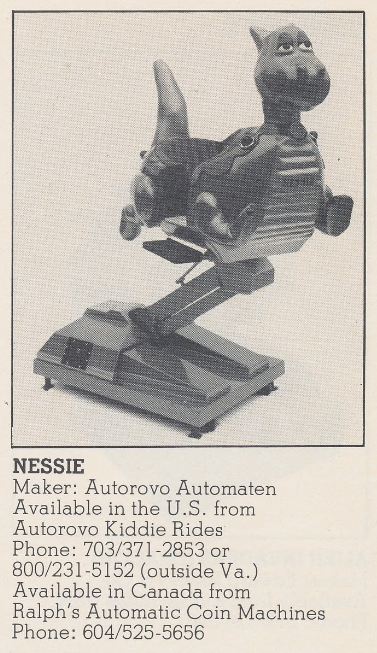
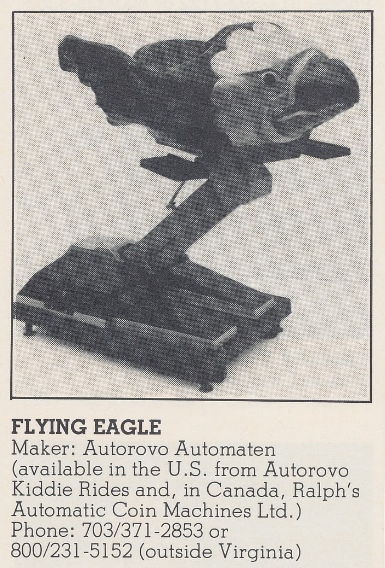
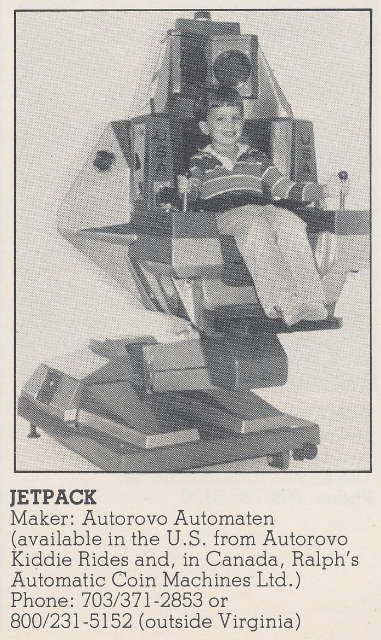
I’m grouping these three together because I have a feeling they’re all essentially the same ride by the same company, Autorovo Automaten, out of Holland.
There’s not really much to these rides, but I will say they look really cool.
Thanks to the YouTube video below (I recommend muting it, because there’s a really annoying sound in the background), I was able to see that Nessie had two buttons in the cockpit – pushing one button engaged the hydraulics, which made the cockpit go up; pushing the other button released the hydraulics, making the cockpit come back down. I can’t confirm it, but I have a feeling the Flying Eagle had a similar control system. And, once again, I can’t confirm, but I’ll bet the Jetpack was the same, but used joysticks instead. So, not very exciting as rides, but pretty neat designs.
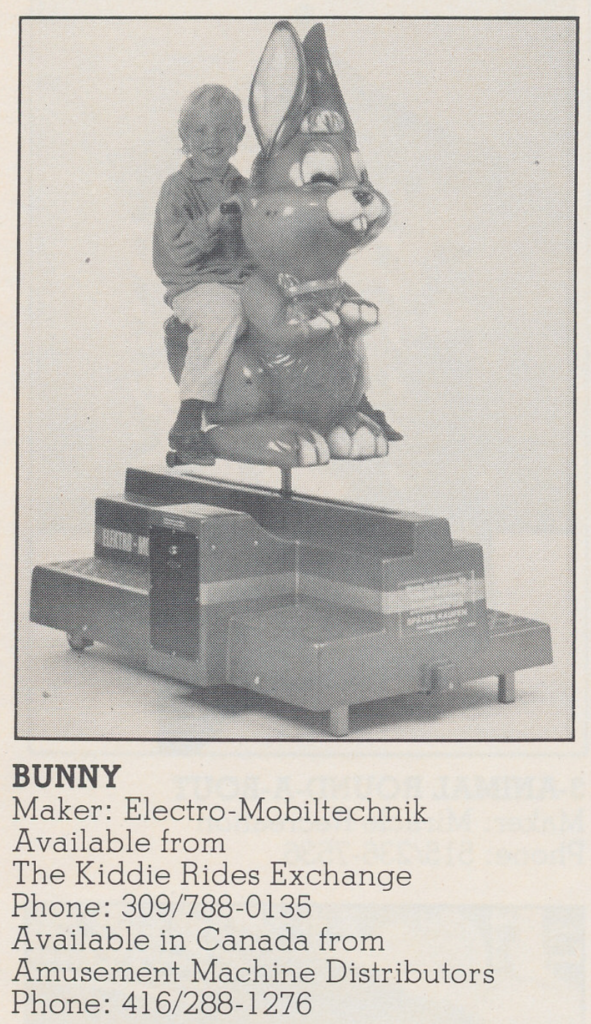
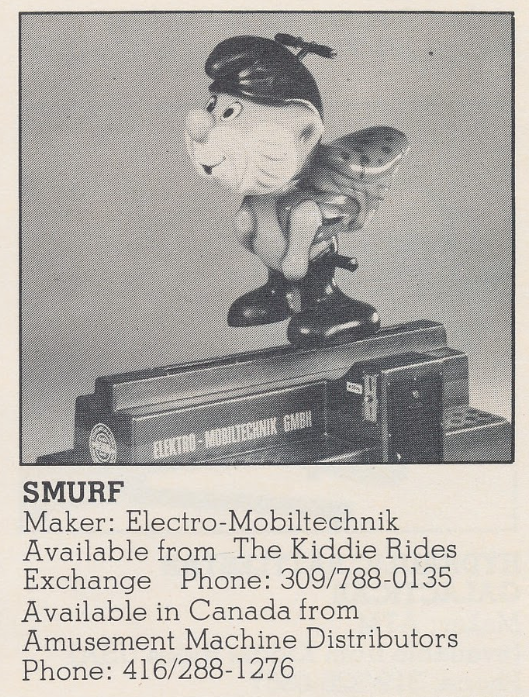
Bunny, Smurf
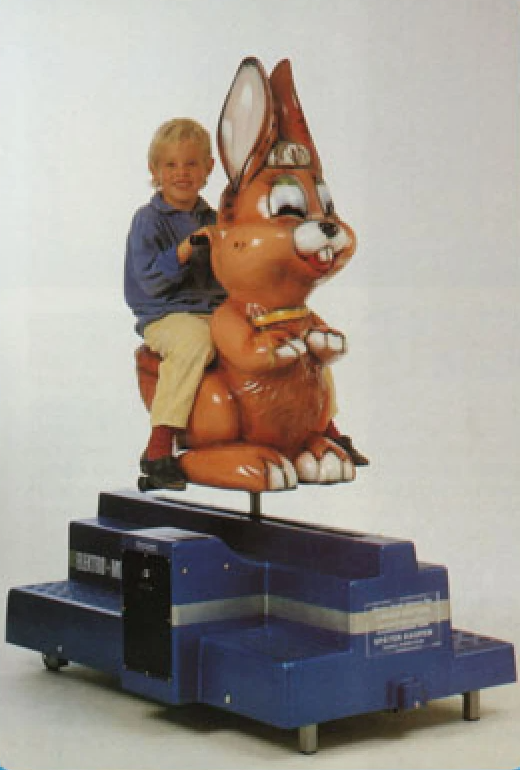
Elektro-Mobiltechnik GmbH (Electric Mobile Technology of Germany [EMT]) was a German ride manufacturer out of Raubach, a small town about halfway between Cologne and Frankfurt. Founded in 1970, the company had a unique manufacturing workflow that allowed them to crank out around 50 machines every day. The company was run independently until around 1992, when it was sold to NSM Group, the world’s largest manufacturer of jukeboxes at the time. It would change hands a few times in the 90s before being shut down in 2004.
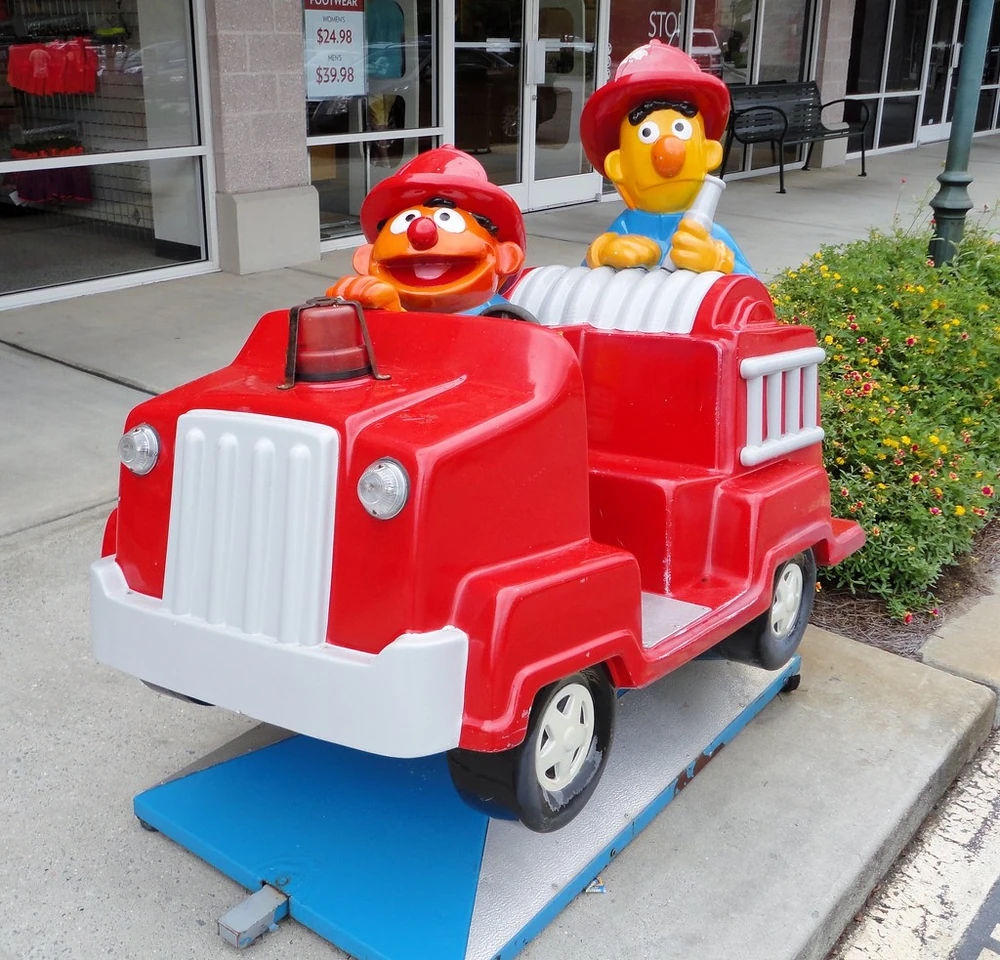
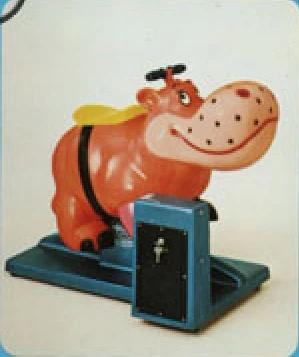
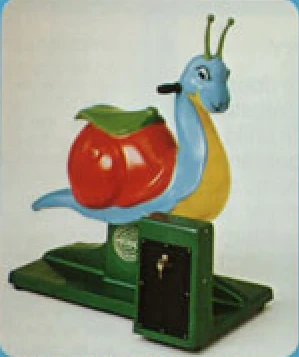
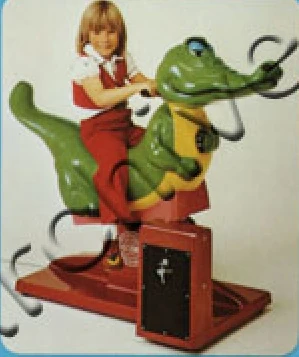
While there are quite a few photos of EMT’s rides online, there doesn’t seem to be a lot of video footage of their earlier machines in operation. However, many of their later rides, especially those that were licensed with Disney and Sesame Street characters, are still running today. Below is a slideshow sample of some of their bigger-name rides (All photos courtesy of Kiddierides.fandom.com).
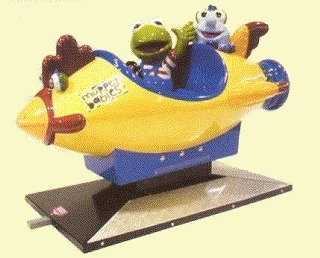
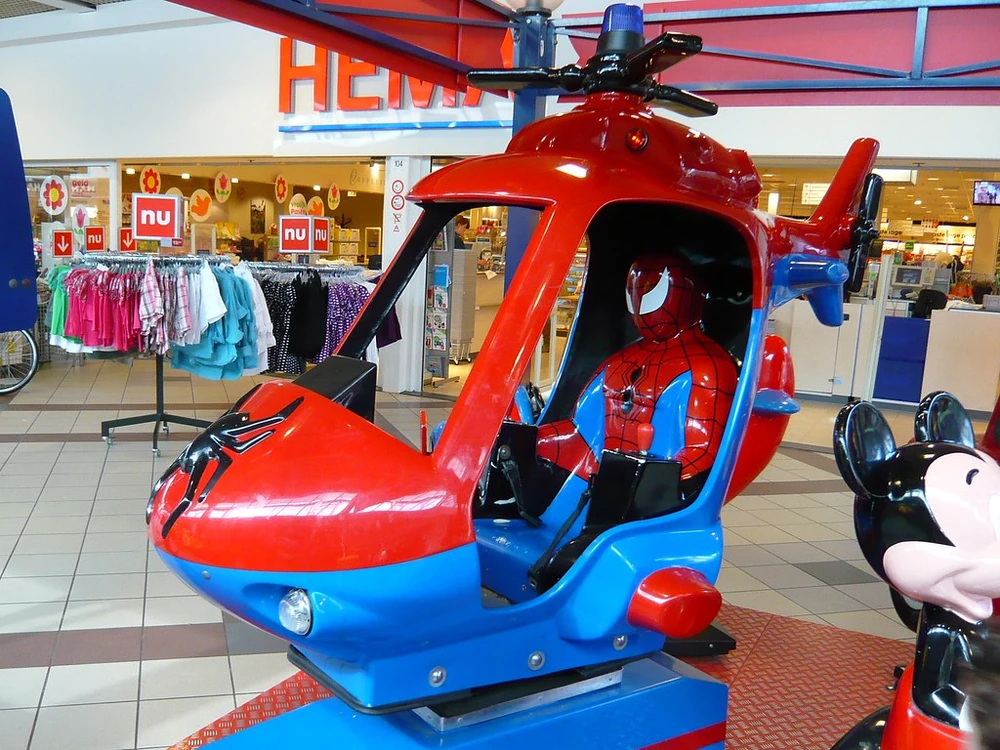
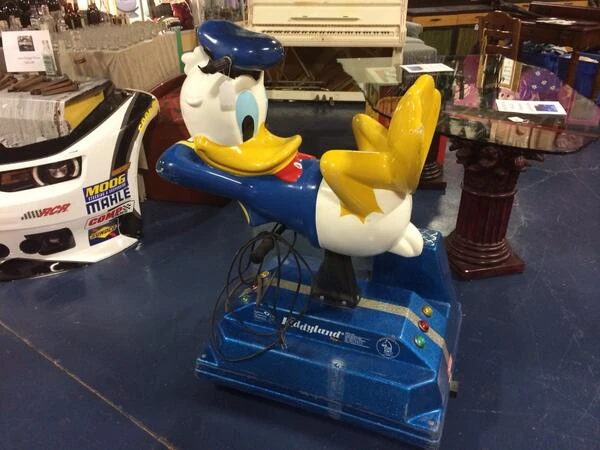
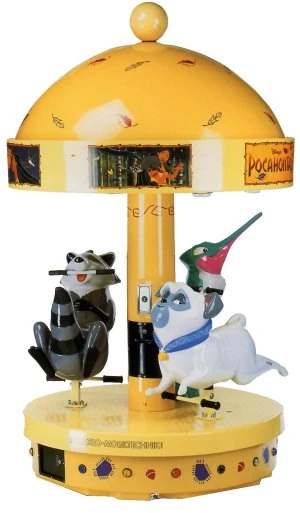
EMT seemed to specialize in animal rides, even if they did sometimes take some weird turns. Aside from The Bunny ride, they also had a hippopotamus, a snail, “Crocky the Crocodile”, “Porky the Pig” (not the same as the cartoon character), a whale, a rhinoceros, “Nessie”, the Loch Ness Monster, a very cursed Hamster, and many more. (All photos courtesy of Kiddierides.fandom.com)
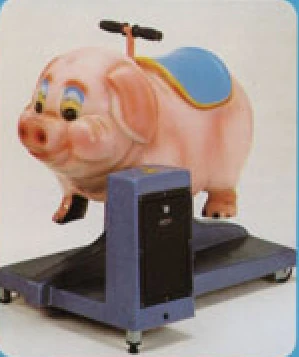
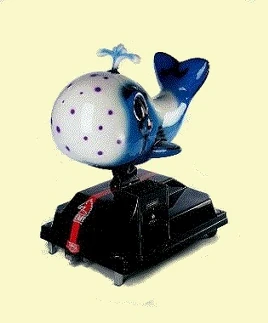
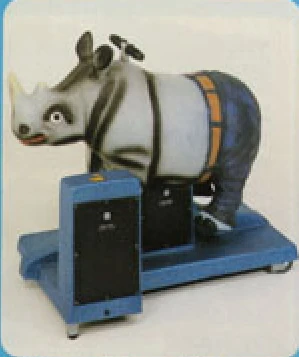
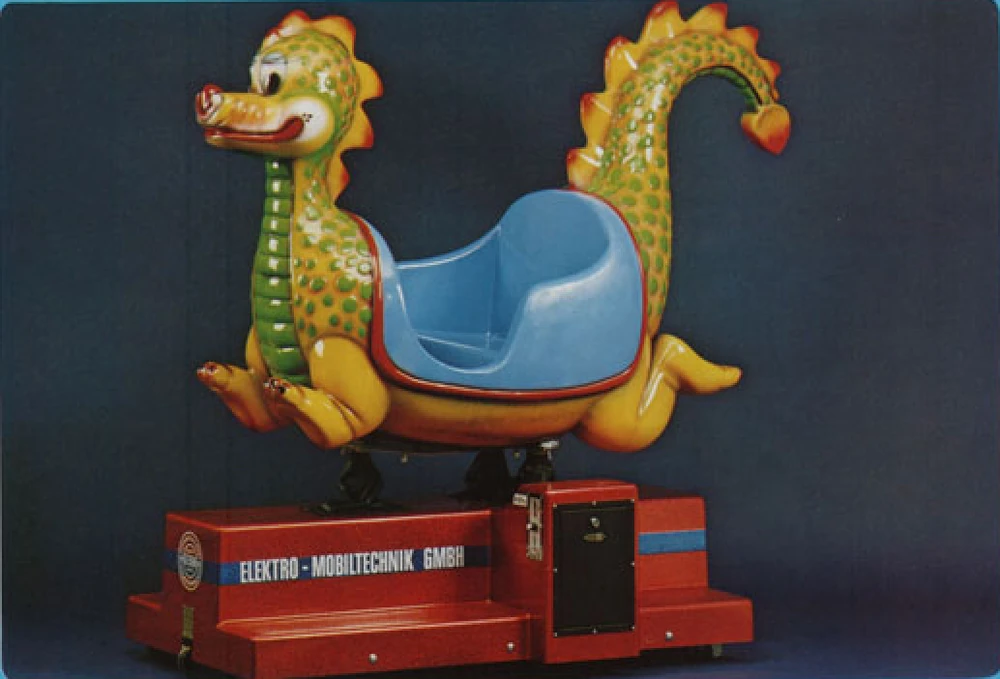
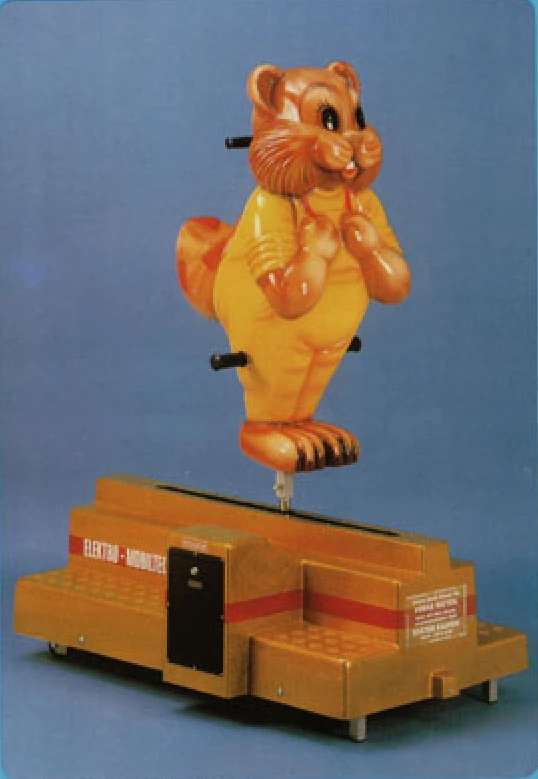
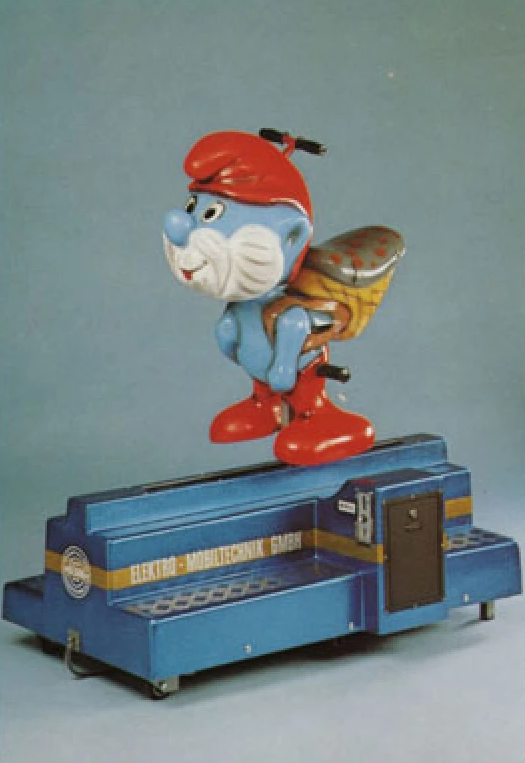
The Smurf ride, released in 1976, was the first licensed ride created by EMT. This probably coincided with the animated Smurfs film, The Smurfs and the Magic Flute, a 1975 Belgian film that was released to more European markets starting in 1976.
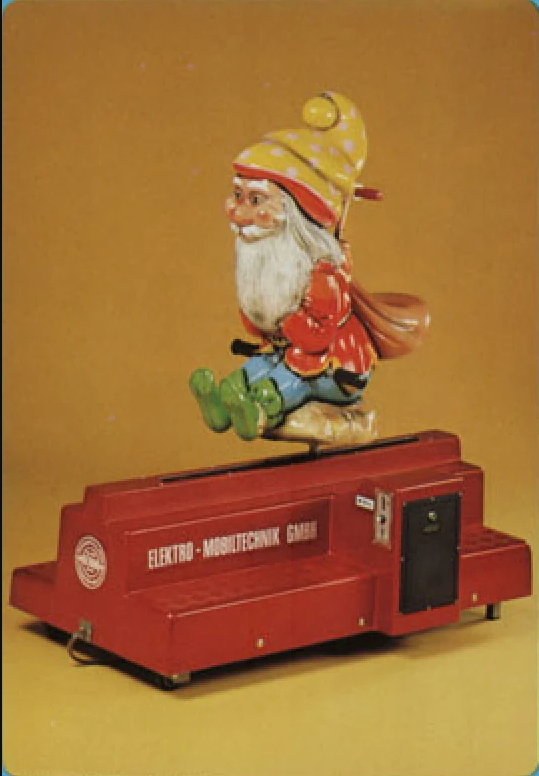
While not exactly the same, they also had a Dwarf ride released in 1977 that had a very similar aesthetic and motion concept to their Papa Smurf ride.
The Smurf ride was discontinued in the 1980s, presumably after The Smurfs’ decline in popularity, but the Dwarf ride would still be manufactured into the 1990s.
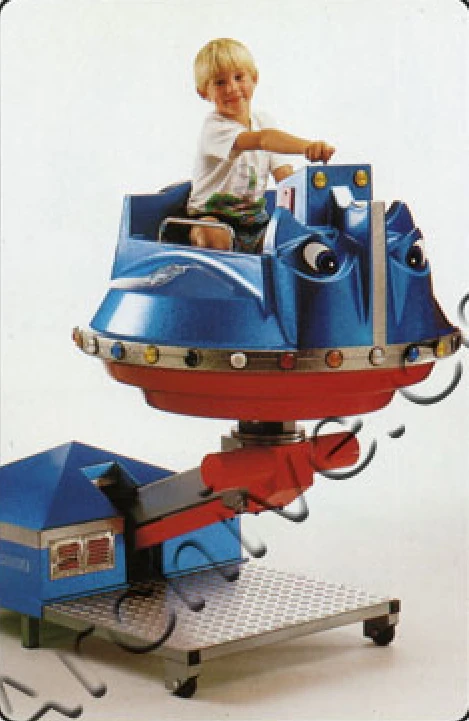
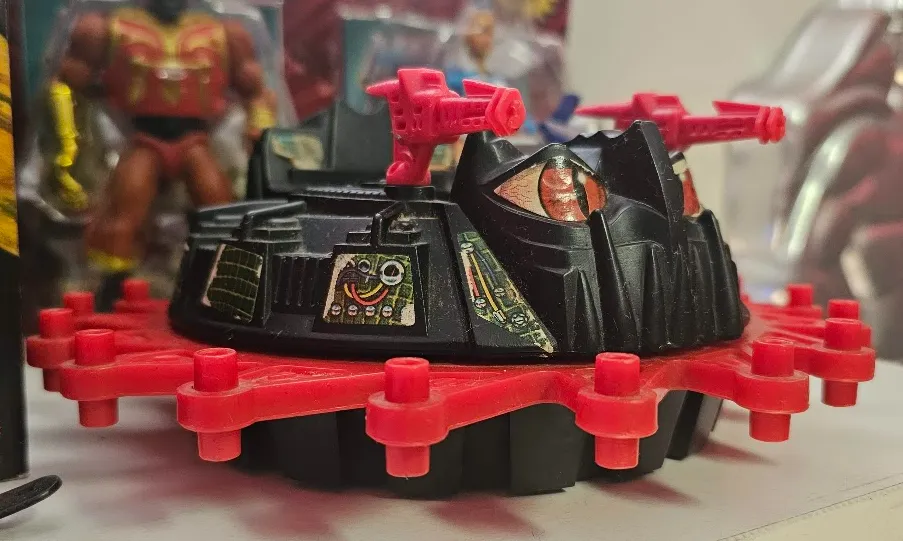
SIDE NOTE: The “Orion” ride from EMT was not listed in this issue of RePlay, but I saw it on the Kiddie Rides Wiki and found its design really fascinating. According to the wiki, the ride was released in 1979 and continued being manufactured until the 1990s. But tell me this doesn’t look like the Masters of the Universe toy, Roton! Based upon the kids’ clothes and the quality of the photo, I’m assuming this catalog picture was taken in the late-80s, after the Roton was released in 1984. Unfortunately, I can’t find any earlier photos of the ride to see if it changed over the years. So, which came first – the Roton or the Orion? This is one pop culture mystery I’d love to find an answer to.
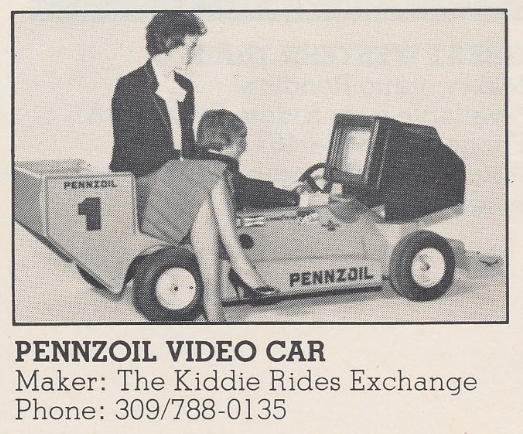
Pennzoil Video Car
This promotional photo for the Pennzoil Video Car dates back to at least 1984, where I saw it in another issue of RePlay Magazine. While I couldn’t find any more information about this specific “video” ride, it seems that most of these types of rides at the time were essentially just kids pretending to drive a car while a looping video on a LaserDisc played on the monitor in front of them. Mom sitting comfortably (and probably very bored) on the back of the ride indicates that’s probably what this was.
However, in my research, I found a 1983 article in Star Tech Journal, a technical magazine for the arcade industry, about a hybrid kiddie ride/video game called “Rally Video Car” from Gino Rondina, touted at the time as Europe’s largest manufacturer of kiddie rides.
Unfortunately there were no photos of the ride, but the article describes it as a car ride that “moves in both a rocking and back-to-front motion” and features a steering wheel and gas pedal that control a video game car on the screen. In the video game, kids drive around a track, passing other cars, dodging oil slicks, and collecting gas to gain points. If they hit another car or go off the track, the on-screen car stops and a crash sound effect plays, but the motion of the ride stops, too. After the crash, when they hit the physical gas pedal, the on-screen car moves again and the ride starts rocking again.
Kids were given a set amount of time to gain at least 400 points. If they hit 400 or more by the time the game was over, the video game car would change into a “little man who jumps frantically up and down” while the sound effect of a crowd cheering would play. The article mentions that they’ve witnessed kids gathered around the ride, competing with one another to see who can get the highest score.
Man, I would love to find video footage of this thing…
Starfighter, Turbochopper, Skyhawk Raider, and SPR1 Spacepod
Bolwell is an Australian company that specializes in fibreglass construction. They started out in 1962 by making kit cars, but soon realized that their expertise with the material could be used for a variety of products, including kiddie rides. I’m assuming “Ride Dynamics” was the name they used for that branch of the business, or it’s entirely possible that’s just the name of the distributor in America; I couldn’t find any more information about them. All of my research points to Bolwell as the actual maker of these rides, though.
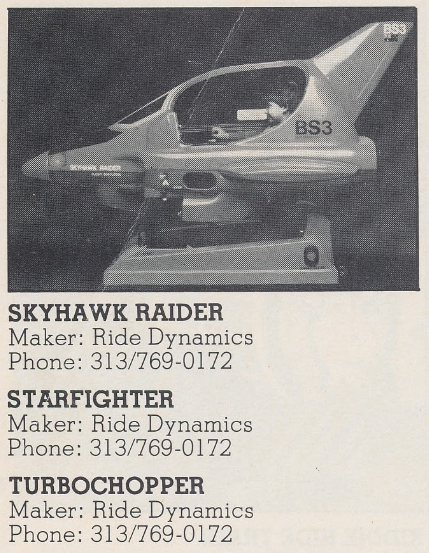
Bolwell produced what they called a “flight simulator” line of rides consisting of the Starfighter BS1, the Turbochopper BS2, and the Skyhawk Raider BS3 (there was also a Stealth BS4 ride, but I can’t seem to find much information about that one). These rides consisted of a fiberglass cockpit with a centrally-mounted joystick that would allow kids to climb, dive, and bank to simulate a variety of airborne adventures. The Starfighter was meant to simulate a space flight mission; the Turbochopper, designed for toddlers with less-dynamic action, let kids rescue firefighters; the Skyhawk Raider gave kids the chance to shoot down enemy planes in an aerial dogfight, the Stealth ride let them fly a stealth airplane.
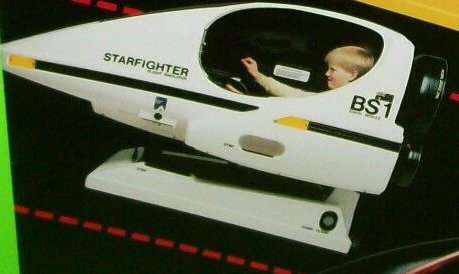
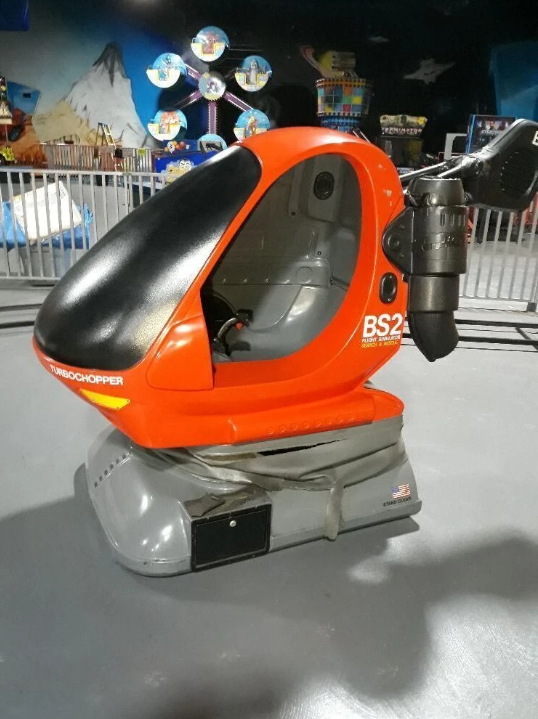
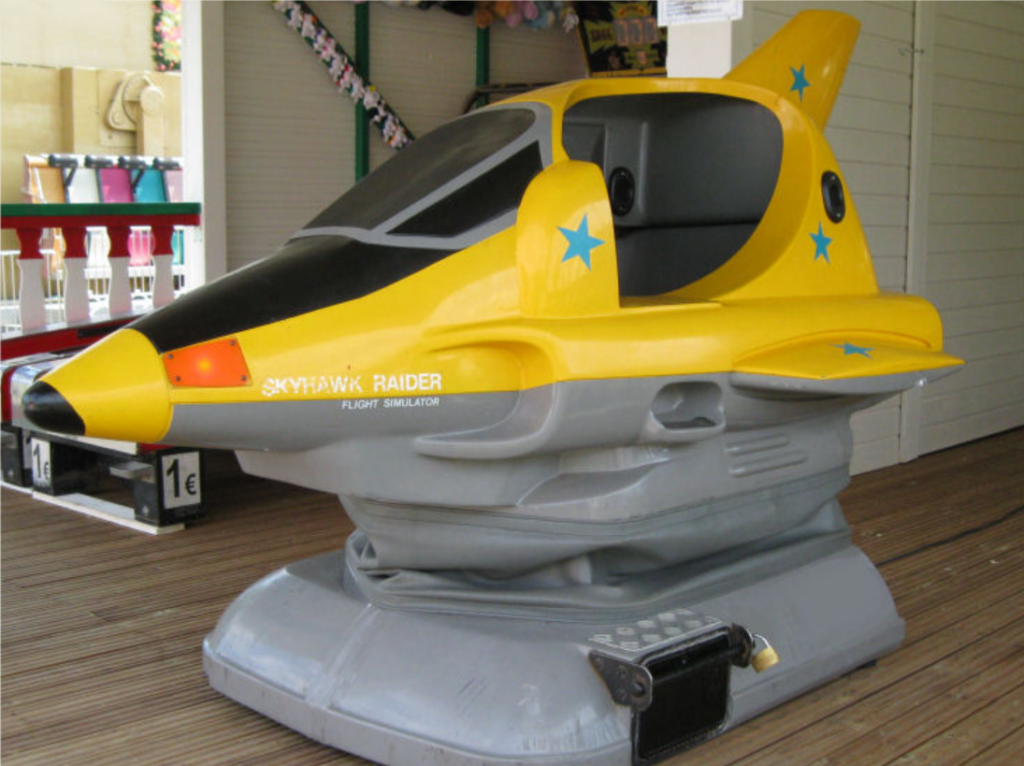
Here’s a video of the Starfighter in action…
And here’s a Facebook video of a Skyhawk Raider that was repaired by Olson’s Coin-Op Restorations.
Unfortunately, Facebook doesn’t let you embed videos without paying a fee, so an external link is the best I can do. It’s a really cool ride though, so it’s worth checking it out.
The SPR1 Spacepod was the first in a new line of rides Bolwell called their “Self-Propelled” line, that also included the Skylab and Moondisc rides.
In the RePlay listing, Bolwell touted the line as being “self-propelled ride; no power required”. The low-quality image in RePlay doesn’t really tell us much about it, but I was able to track down a copy of Play Meter Magazine, a competitor arcade trade magazine, from September 1988, that shows a better picture of the Spacepod, as well as the Skylab rides. I couldn’t find a picture of the Moondisc, but I have a feeling it was a similar design.
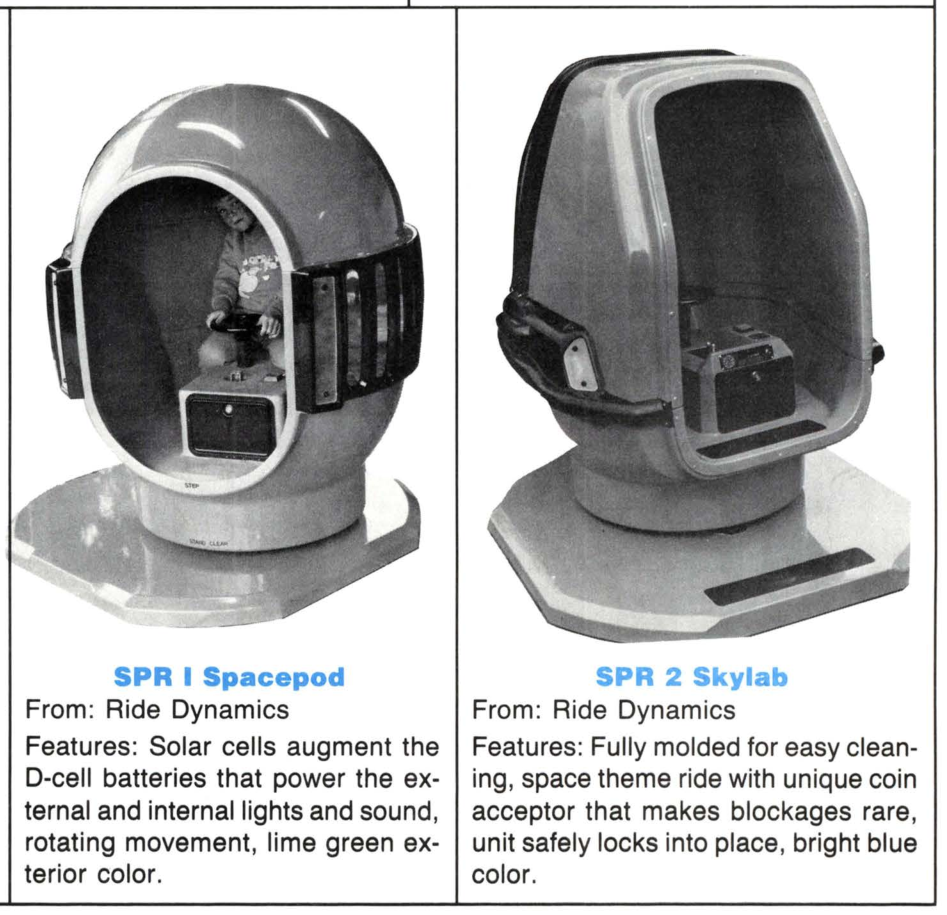
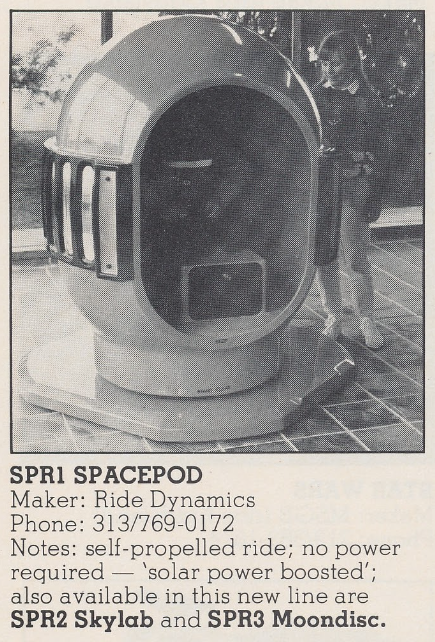
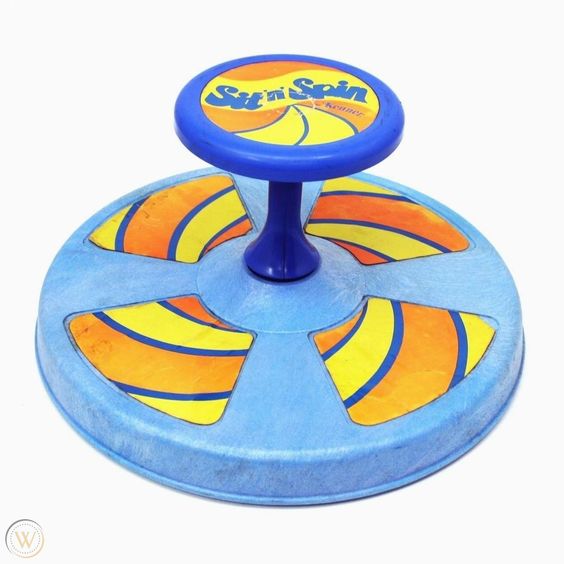
There’s still no description of just what the ride is, but it kind of looks like maybe the ride functioned something like the Sit’n Spin toy that we all had growing up. Perhaps the kid inside turned that wheel and made the whole thing spin, surely making him dizzy, but loving every minute of it. From the description in Play Meter, the lights and sounds were controlled by a D-cell battery, but solar cells could augment that power as well. Kind of a wild idea, especially for the late-80s! But since it was all kid-powered, even if the lights and sounds weren’t working, the ride could still function.
Bolwell is still in business today, still making cars out of fibreglass and other lightweight materials. However, at some point it seems they sold their kiddie ride designs to BAFCO, Ltd. in Britain.
Speaking of BAFCO…
Space Shuttle
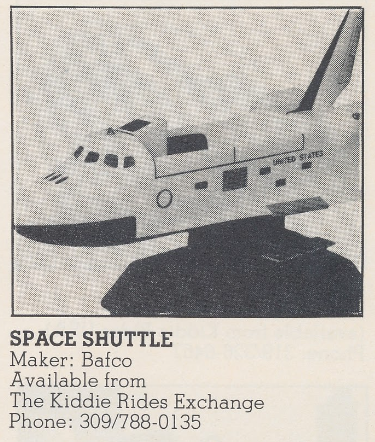
According to “The History of Coin Operated Rides” on YouTube, this ride, whose full name was “Columbia Space Shuttle”, was designed by David Fox for BAFCO, a British company founded in 1980, that would go on to become one of the largest kiddie ride manufacturers in the UK. The Space Shuttle ride was their big debut at a 1981 industry show in New Orleans. The real-life Space Shuttle Columbia launched for the first time that same year, so it was very much in the zeitgeist, and arcade owners saw the ride as a great money-making opportunity. What kid wouldn’t want to fly the Space Shuttle!? BAFCO left the convention with over $40,000 worth of orders – that’s about $147,000 in 2026 dollars. Not a bad debut.
The ride is pretty simple – you insert your coin and the Shuttle sways up and down and back and forth. There’s a joystick inside the cockpit to give kids the feeling of flying the ship, but it doesn’t actually control anything. Check out the YouTube video from “The History of Coin Operated Rides” to see it in action:
BAFCO would eventually begin manufacturing rides originally produced by a British kiddie ride competitor, Edward Brooks & Company. I can’t find any information about them, other than an old mailing address and a few scant mentions in arcade trade magazines. But, man, they had some really cool rides! Let’s take a look…
Alien Invaders
Right off the bat, I have to show you a color photo of the Alien Invaders (Dracon) ride, because the black-and-white of RePlay does not do it justice…
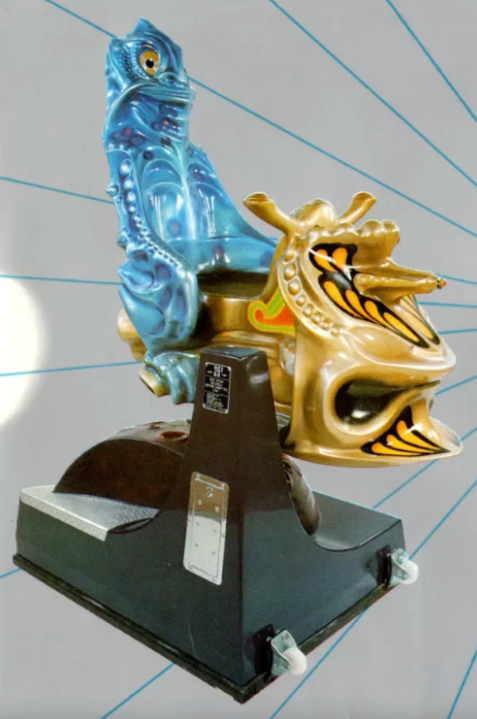
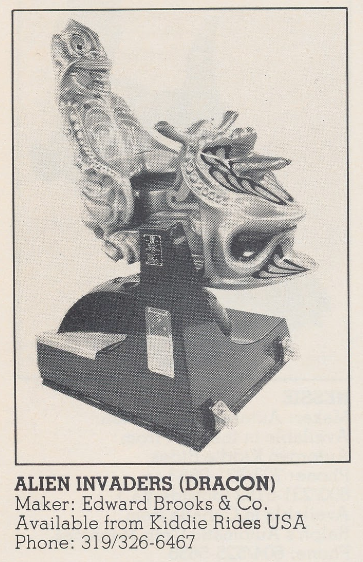
Now would you rather drop your quarter into this thing or the same boring, old pony ride?
From my research, it appears that the ride’s name was actually “Alien Invaders Korax”, not Dracon. Draakon was the name of another ride that was clearly part of this same series, called the Draakon Maurader. The ride came in two variations, a rocking ride and a lifting ride (photos courtesy of Kiddierides.fandom.com).
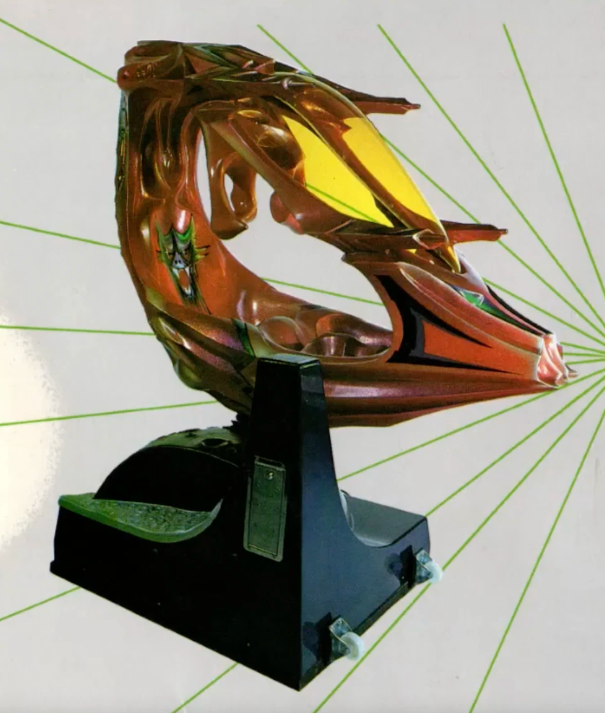
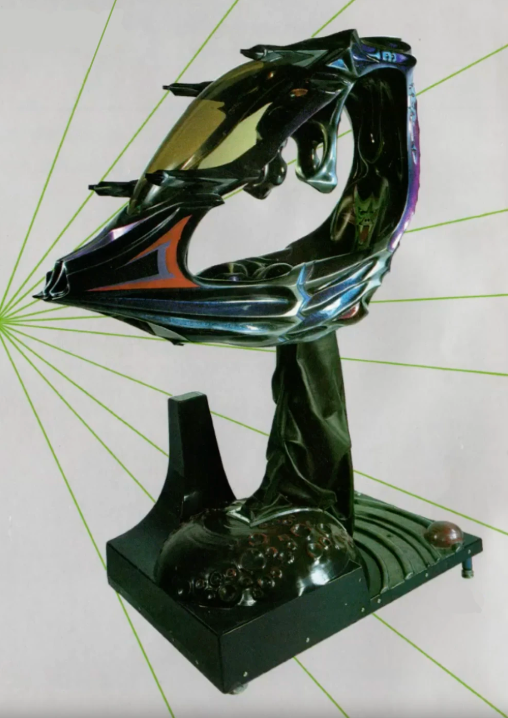
There was also another Alien Invader ride, called “Alien Invader Libellulas”, which is just as amazing as the Korax design.
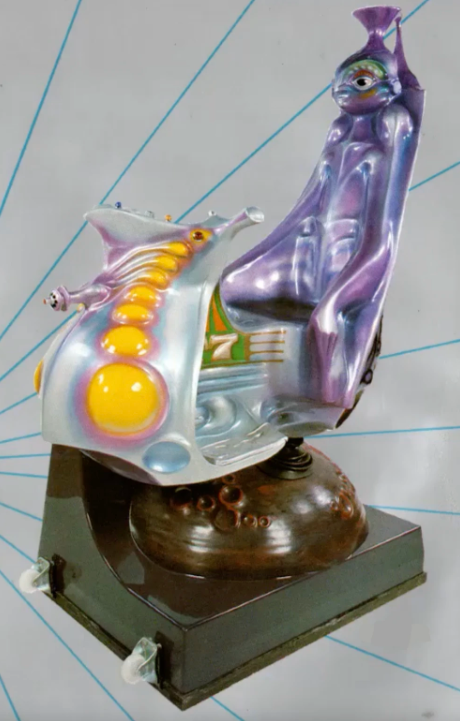
And finally, another spaceship design called the Alien Interceptors, which also came in lifting and rocking variations (photos courtesy of Kiddierides.fandom.com).
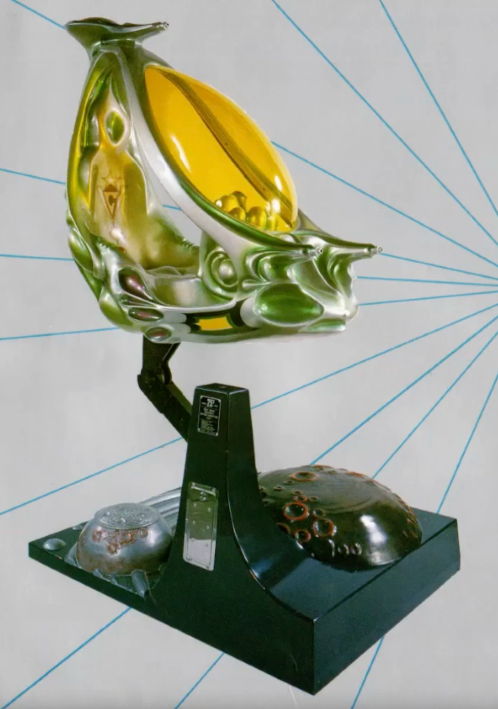
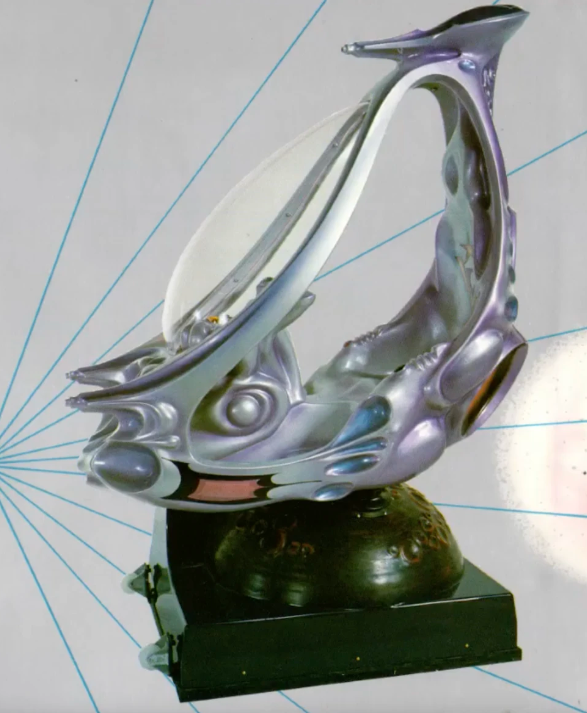
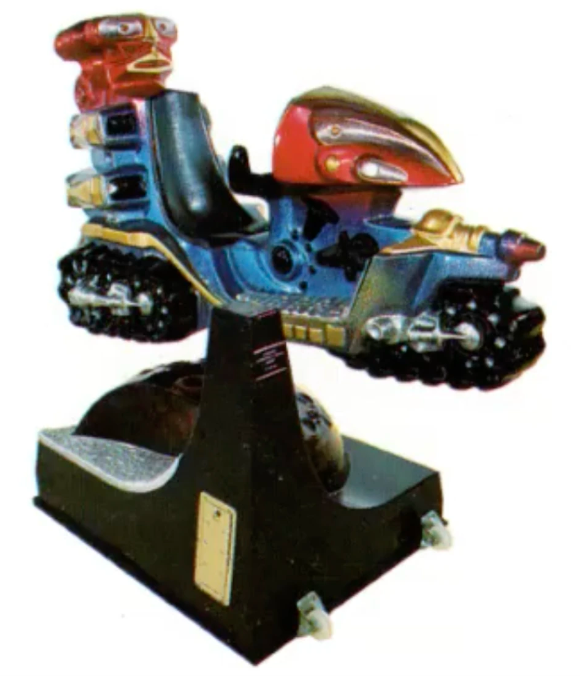
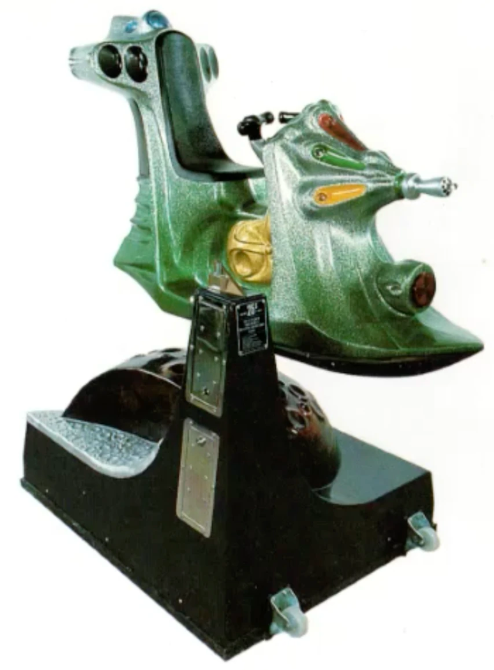
While they aren’t quite as trippy, Edward Brooks (and later BAFCO) , also released a couple of rides that look like they could have been lifted from the 1980 film Flash Gordon or wouldn’t be out of place as part of the Masters of the Universe toy line. The “Galactic Tracker” is on the left and the “Sea Scooter” is on the right. Both great designs that, again, are so much better than another boring, old kiddie ride (photos courtesy of Kiddierides.fandom.com).
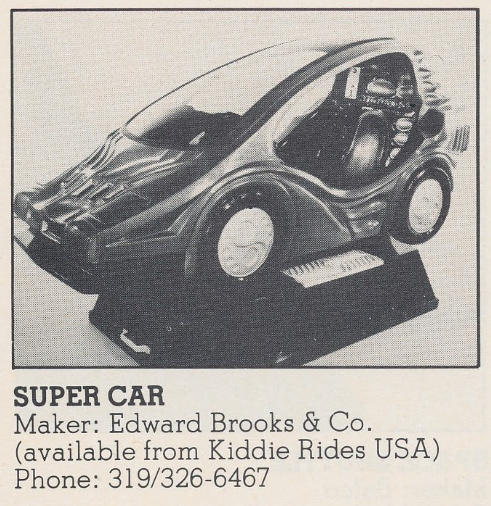
Super Car
When it comes to the “action” of the Edward Brooks/BAFCO Super Car, there wasn’t much to it. Watching this video of the car shows that it’s literally the same mechanism as BAFCO’s Columbia Space Shuttle ride – just sort of undulating back and forth – but, wow, the design and paint job on this thing was amazing!
Eventually, BAFCO got into licensed rides, like Teenage Mutant Ninja Turtles and Tiny Toons, and this would soon make up a large percentage of its business.
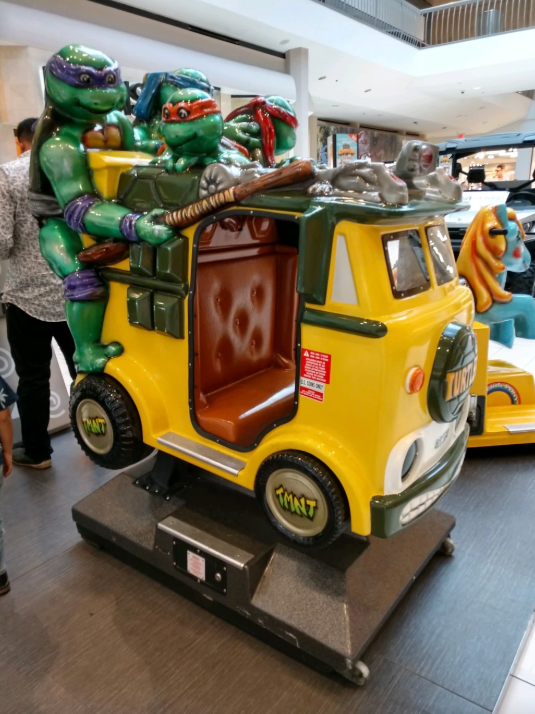
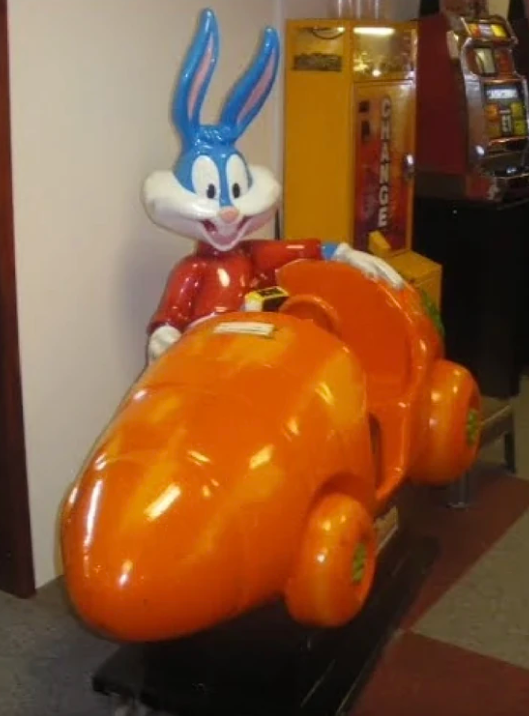
BAFCO was a leader in British kiddie rides from 1981 until right around 2003, when they went out of business. There was a promise of a revival for the company in 2018, but as of today, it never happened.
Knight Rider
At one time, Carousel International was America’s largest manufacturer of kiddie rides. The company was started in St. Louis in 1968 by Norwood Veatch, but he later moved the operation two and a half hours southwest to the small town of Eldon, Missouri. Most of Carousel’s business was supplying K-Mart stores with coin-operated ride-on machines like their most famous ride, Thunder Horse.
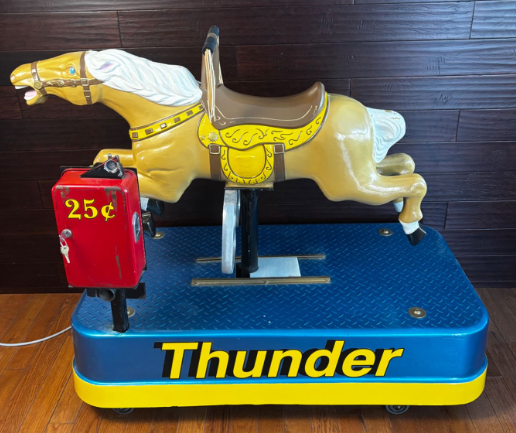
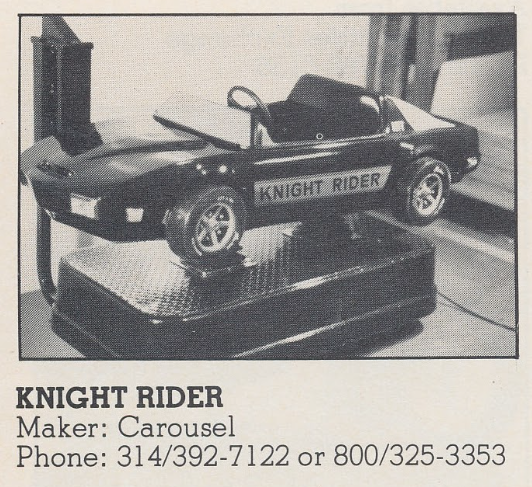
Unfortunately, as K-Mart stores began to close in the early-2000s, Carousel’s business also declined. In 2007, third generation owner Steven Veatch, decided to close up shop. Over the course of the company’s 40 year history, they manufactured over 75,000 rides.
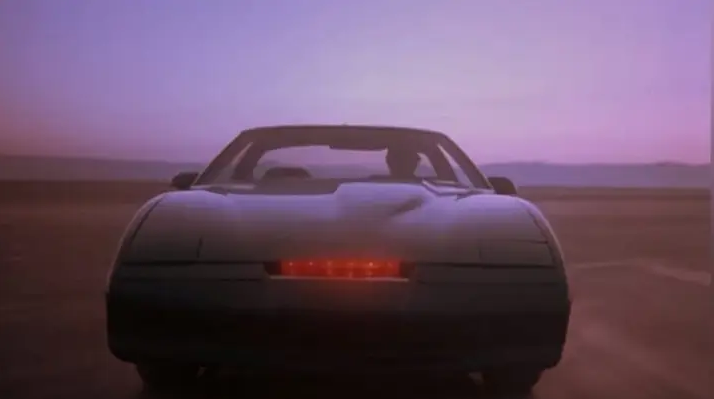
The “Knight Rider” kiddie ride is based on the TV series of the same name that aired on NBC from 1982 until 1986. I couldn’t find anything to confirm that this was an officially licensed kiddie ride, but I would imagine it would have to be since the form factor is clearly based on K.I.T.T., the robotic Pontiac Firebird Trans-Am from the show, and it literally says “Knight Rider” on the side.
From the videos I’ve been able to find on YouTube, it doesn’t look like Carousel went all-out to really make this an unforgettable Knight Rider experience, though. There are a few buttons on the dashboard that play music, a couple of light features – including a single light in the hood to simulate the signature sweeping scanner light of the car on the show – and some generic engine sounds while the car undulates.
Thankfully, this wasn’t the only Knight Rider kiddie ride.
While Knight Rider was an American production, it was very popular in Spain under the name El Coche Fantastico (The Fantastic Car). So, in 1984, Falgas, a Spanish manufacturer of kiddie rides, produce their own El Coche Fanastico ride.
The ride proved so popular that it was in production long after Knight Rider went off the air. According to kiddierides.fandom.com, there were four versions over the span of about 12 years (all photos courtesy of Kiddierides.fandom.com).
Version 1 from 1984 had a Fantastic Car logo on the back windshield and had a fully-enclosed cockpit.
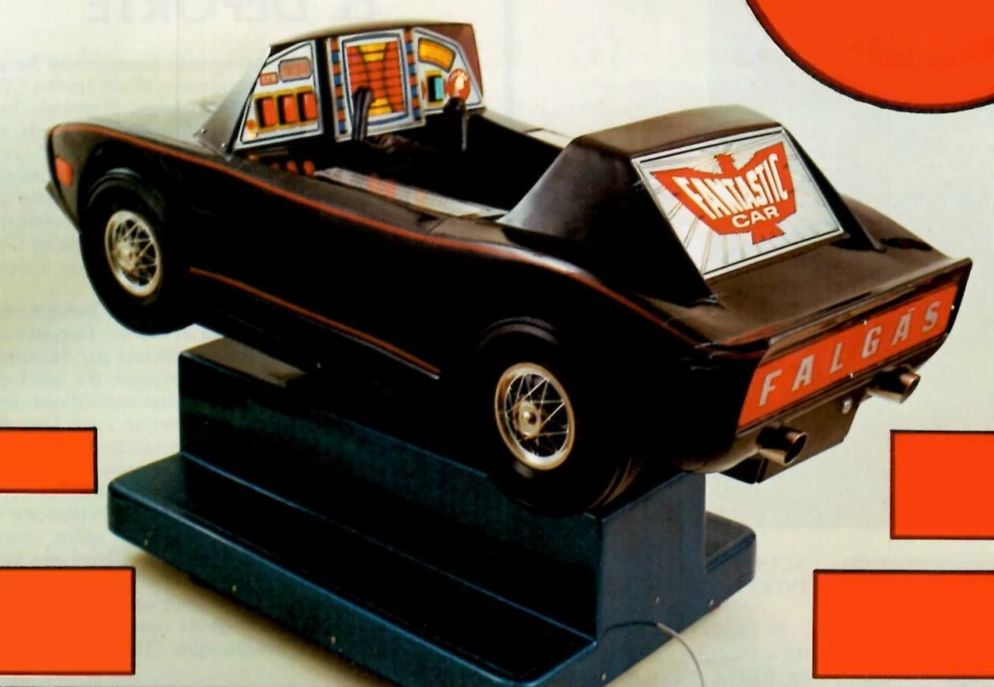
Version 2 from 1990 was essentially the same with a few added touches, including an open doorway on the side.
This is the version I see most often online.
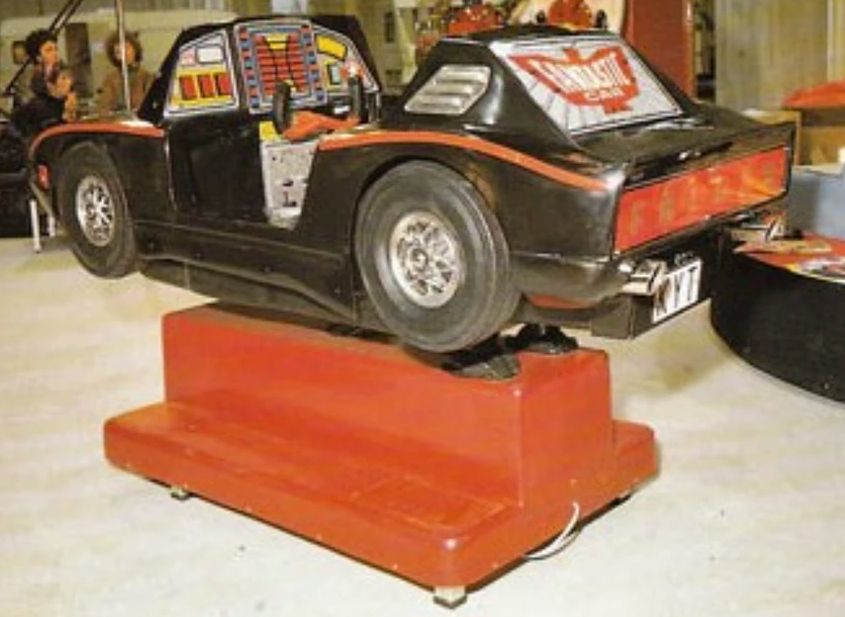
Version 3, from 1992, replaced the Fantastic Car logo on the back with a photo of David Hasselhoff and K.I.T.T.
This is a pretty great version, because nothing beats The Hoff.
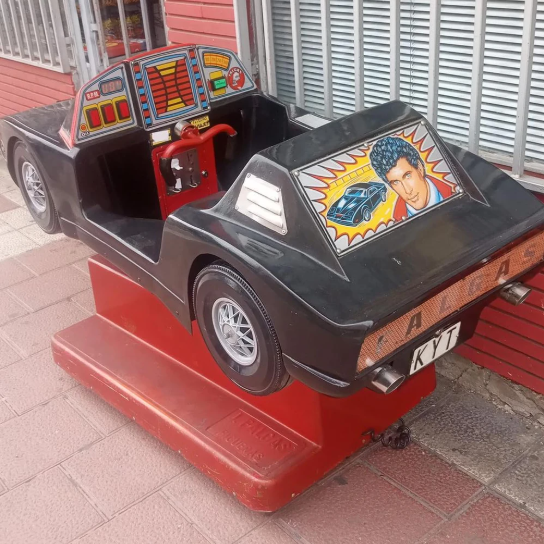
A fourth version was released in 1996, with a step added for kids to get in and out easier.
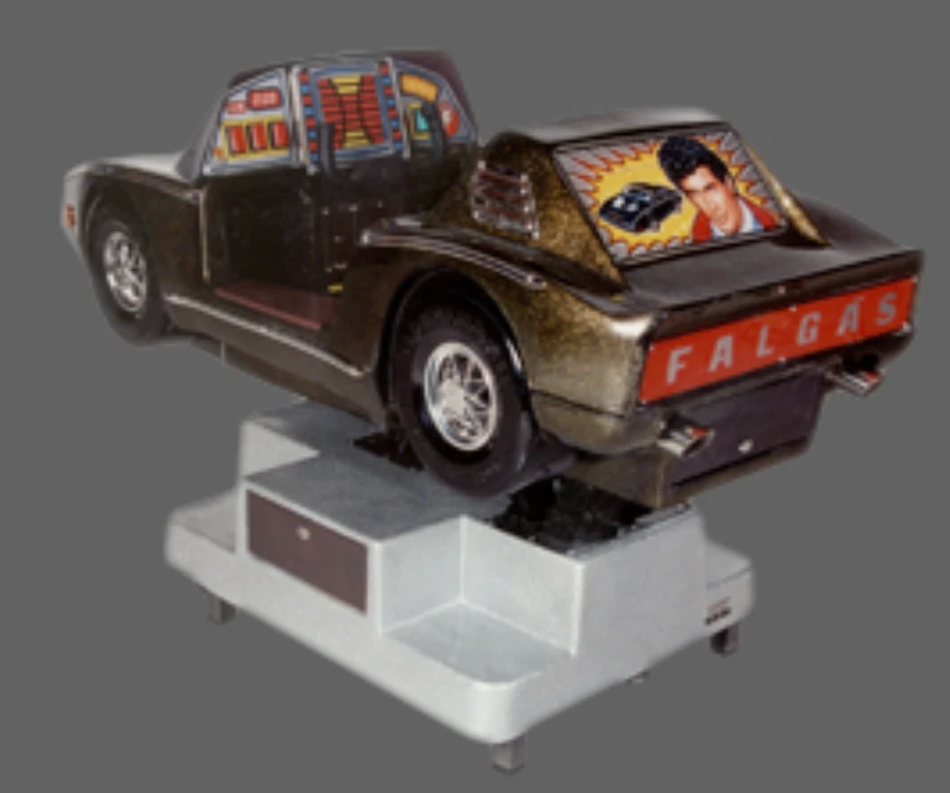
No offense to Carousel, but if I only had one quarter to spend, I think I know which Knight Rider car I’d choose.
Hydraulic Battlestar Galacticar
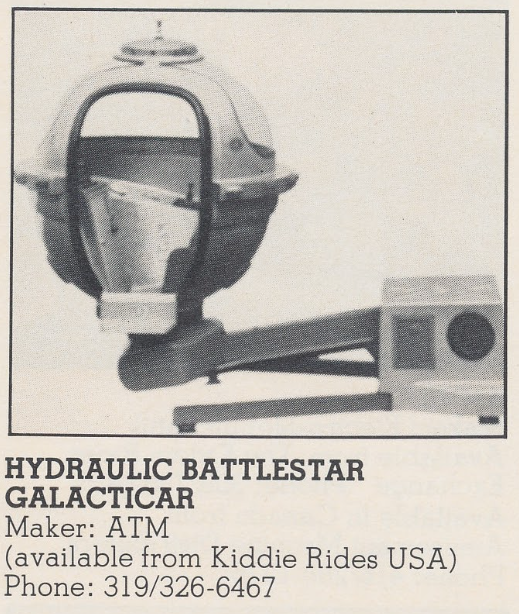
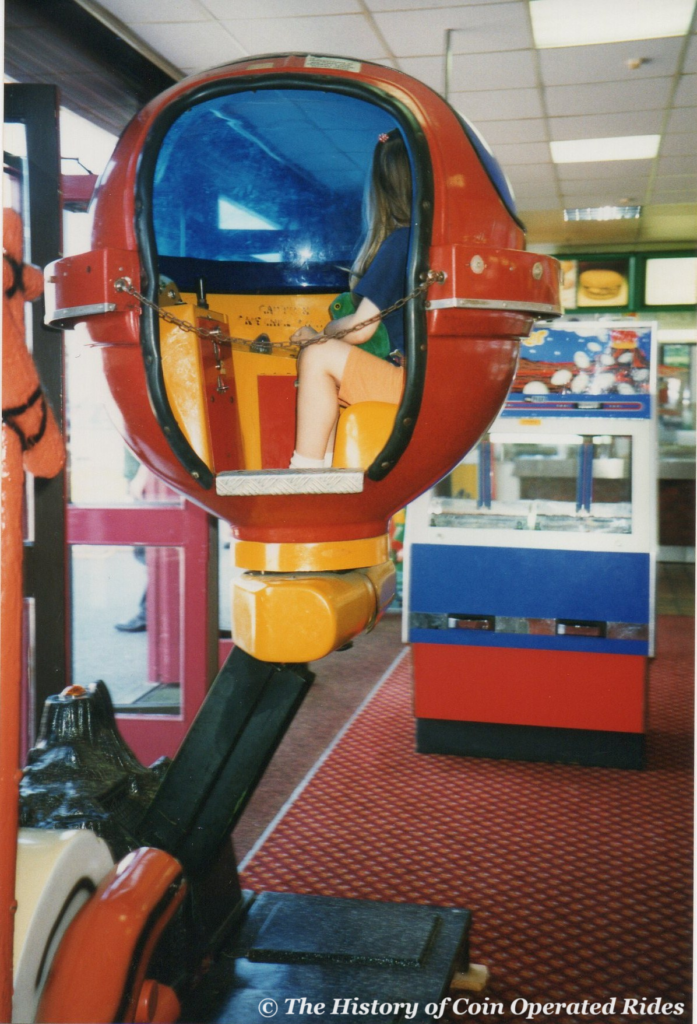
The Battlestar Galacticar was produced by Automatic Toys Modena (ATM) out of Modena, Italy starting in 1980. As with a lot of kiddie rides, the Galacticar was more hype than hyperspace. The ride consisted of a small capsule with a doorway cut out and a chain across the entrance to keep kids inside. The capsule was set on top of a hydraulic arm that lifted the capsule into the air. At the highest point, the capsule would slowly spin while the kid inside pretended to operate spaceship controls. After a few spins, the capsule would come back to the ground. I can’t find any evidence of this, but I’m hoping this series of events would occur a few times before the ride was over, otherwise that would be a total waste of a quarter.
The capsules came in a variety of colors and originally had the “Galacticar” name painted near the door, but that decoration was eventually dropped (as you can see by the photo from the RePlay issue). I’m not sure if that was an internal design decision or if someone from the legal firm that represented Battlestar Galactica sent a strongly-worded letter. There were two versions of the ride – one with a more machine-looking base and another with a base made to look like a rocky planet.
Here’s a very brief video of a Galacticar in action:
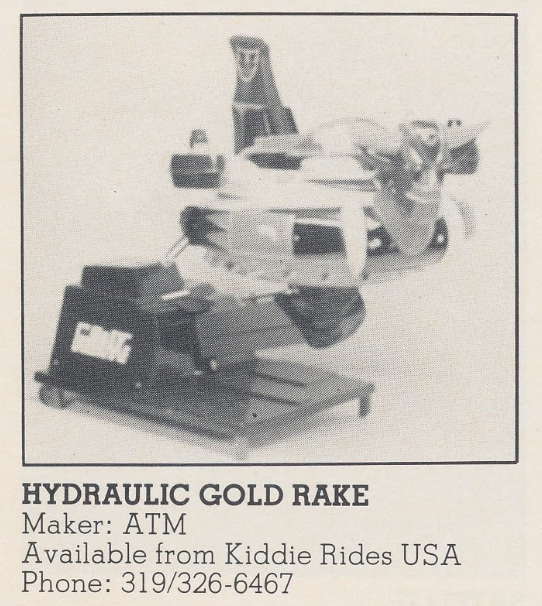
Hydraulic Gold Rake
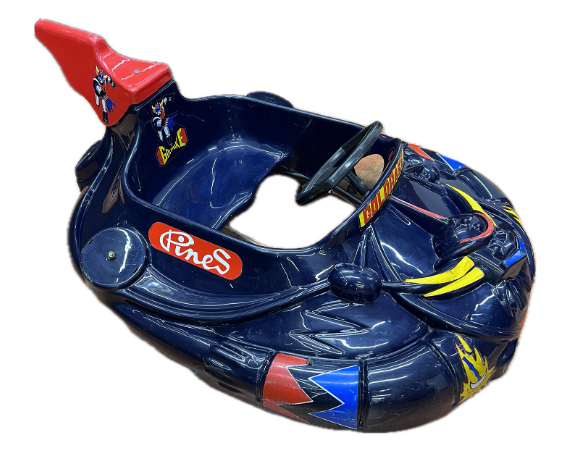
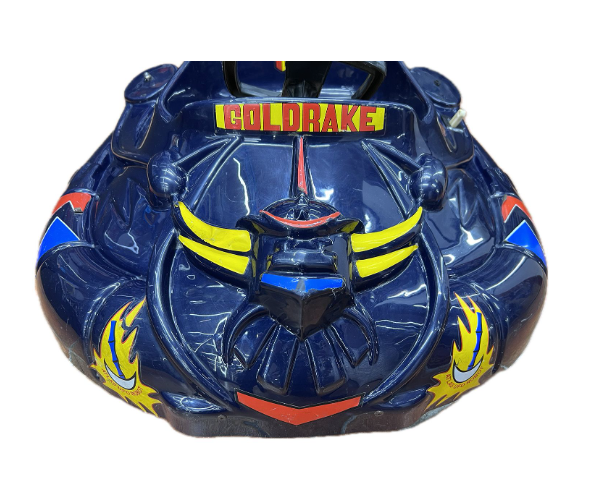
If you’re not up on your giant Japanese robots, you might not recognize this “Gold Rake” ride from ATM. Goldrake (this is the correct spelling vs the RePlay Magazine listing) was the localized Italian name for the titular robot in UFO Robot Grendizer, a manga and anime TV series that ran in Japan from 1975 to 1977.
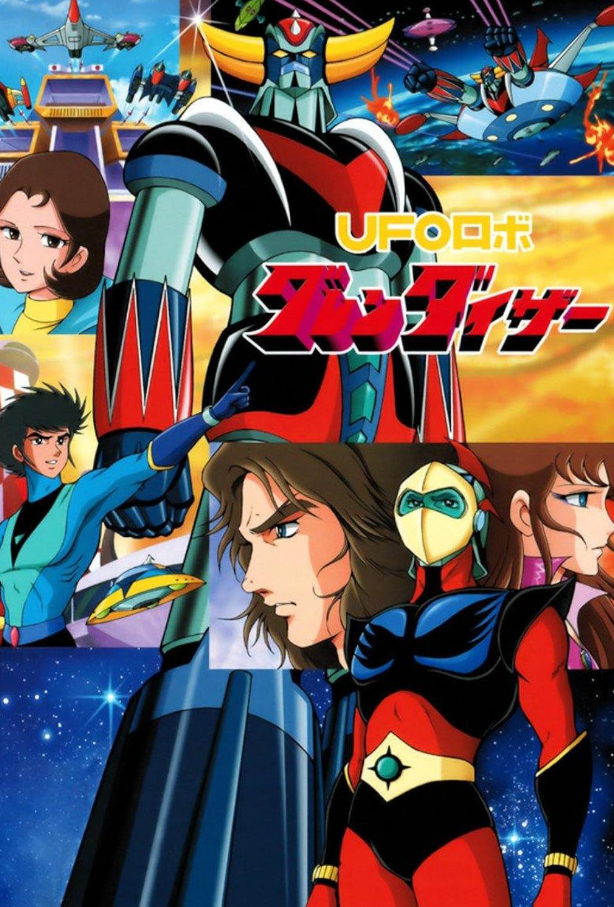
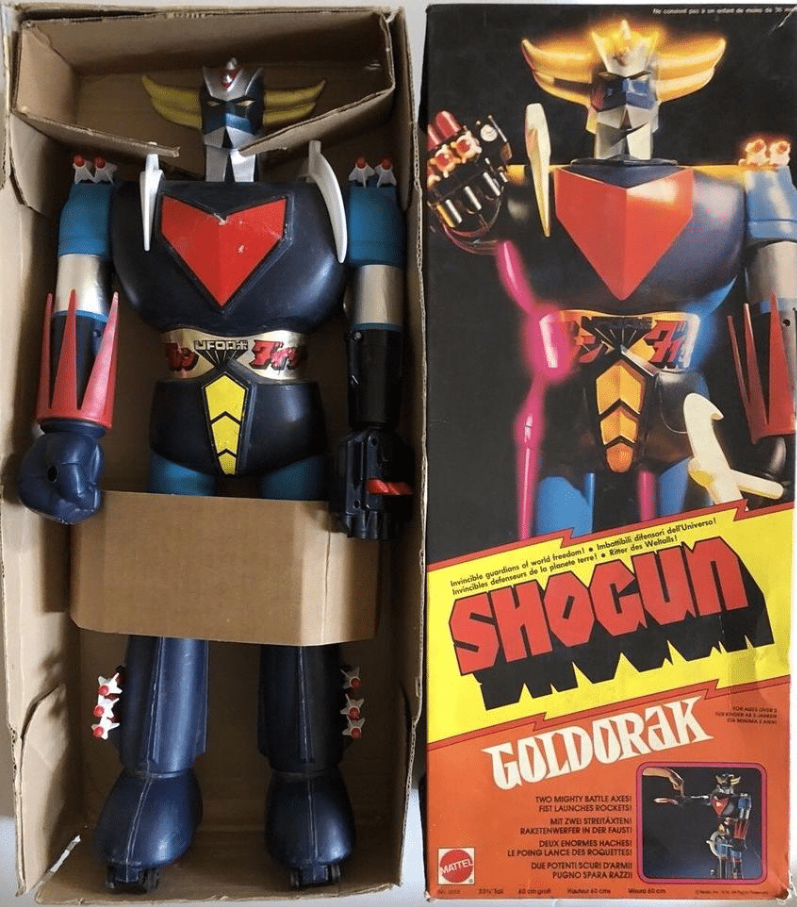
Grendizer was a big hit in Japan and has essentially never really left the pop culture landscape there. You can still buy toys, video games, and manga based on the series. It was also the first anime series to become popular outside of Japan, especially in Europe and the Middle East. The name was changed to make it more regionally-friendly, going by Goldorak in France, and Goldrake in Italy (which is where the ride company, ATM, is located). The character even made it to the states as part of the Shogun Warriors line of toys and animation, where he was known as Goldorak.
The ride from ATM appears to be based on Grendizer when he’s changed into flying saucer mode. The designers scaled it back a little bit, but as you can see from the photos below, it’s still a pretty close match.
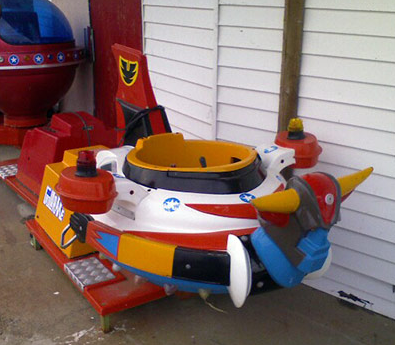
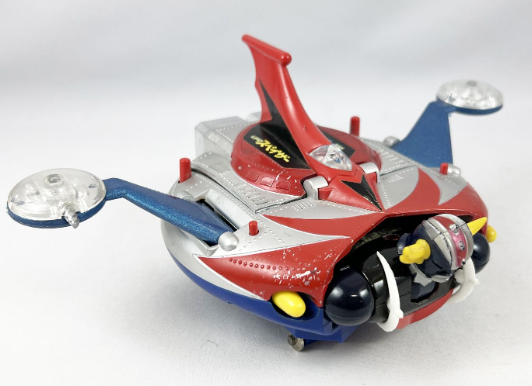
Much like the Knight Rider/El Coche Fantastico situation, I found a few different Grendizer kiddie ride designs. Here’s a slide show with more:
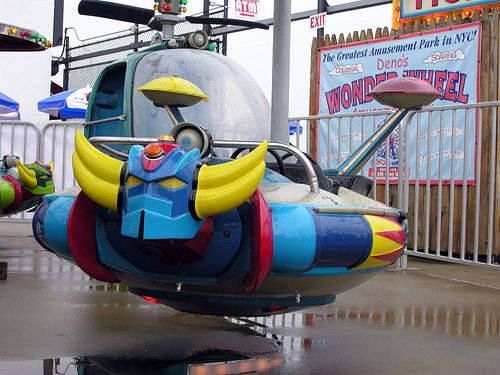
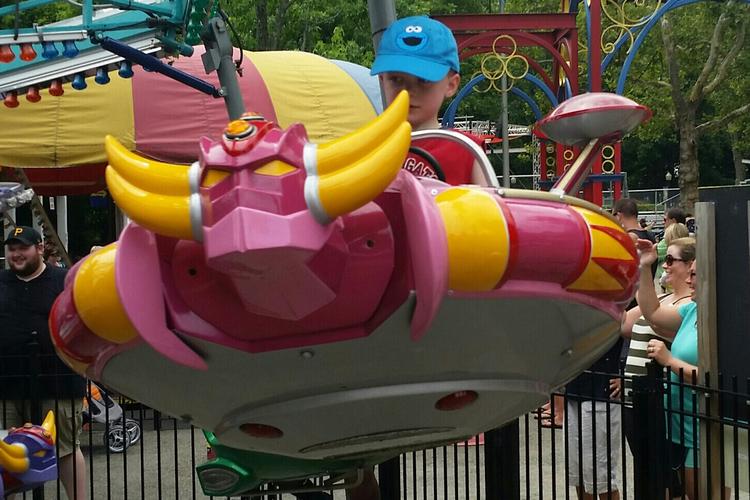
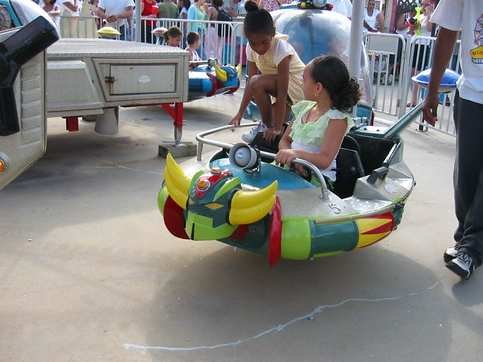
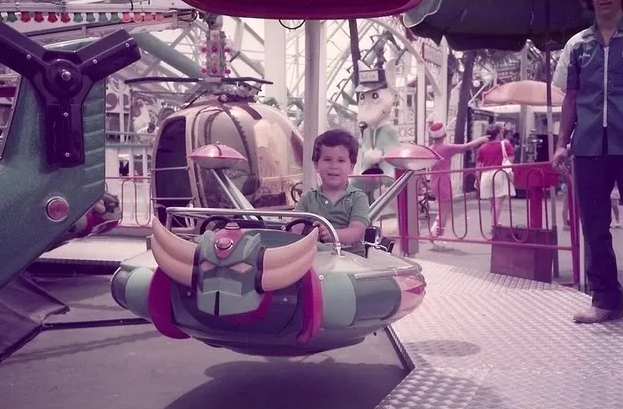
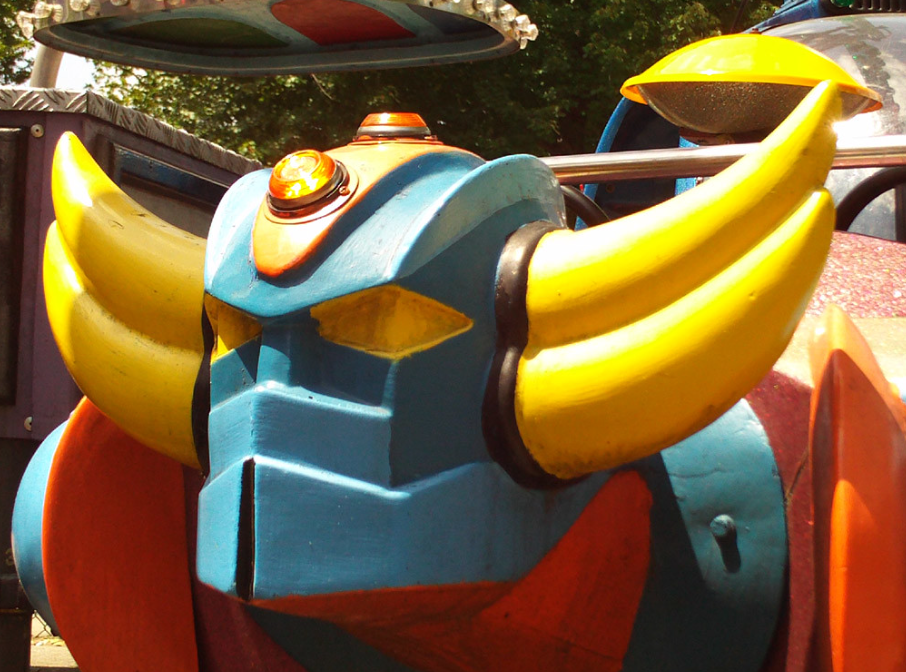
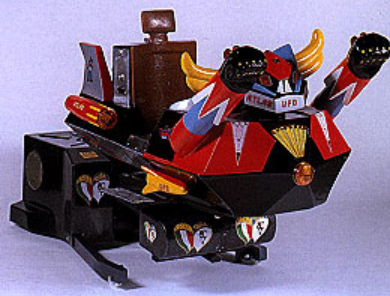
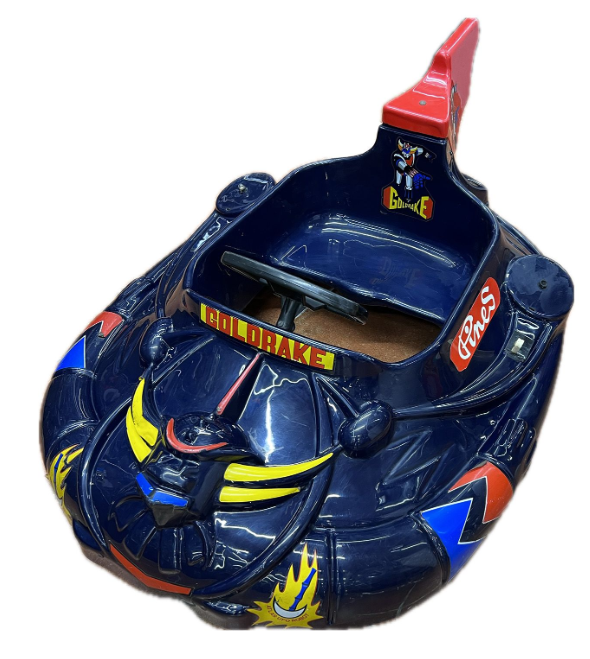
You can even buy your own Grendizer/Goldrake kiddie ride from lulu-berlu.com in France. Here are some photos from the listing:
Star Wars
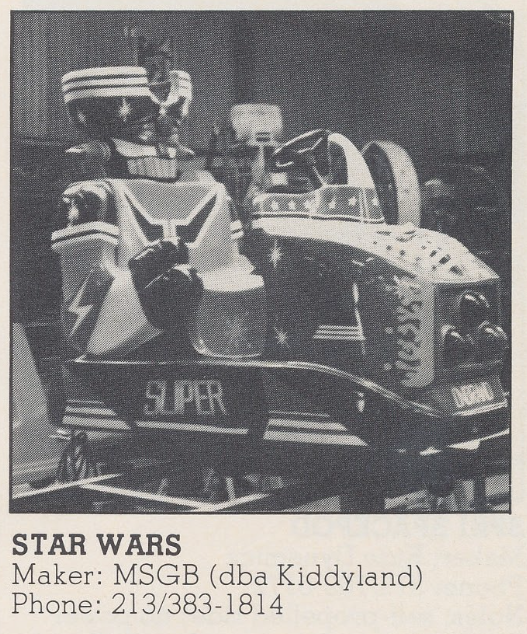
In 1987, Japanese animation was very, very niche. Sure, some kids knew about Speed Racer, Voltron, and Battle of the Planets, but these weren’t nearly as popular among “normies” as shows like Scooby-Doo, Looney Tunes, or Masters of the Universe. So, when MSGB (DBA Kiddyland) saw this crazy-looking kiddie ride in their import catalog, I’m sure they just assumed that this robot was supposed to be a knock-off Darth Vader.
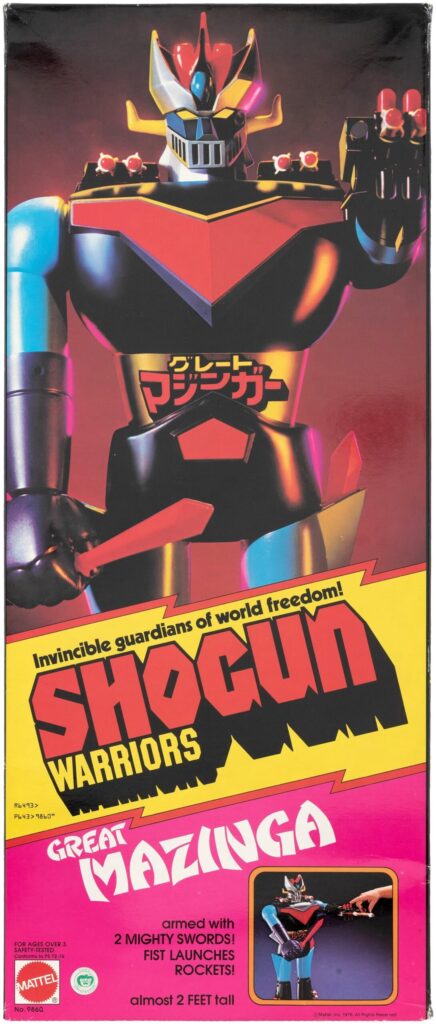
However, that’s not Darth Vader, that’s Mazinger Z, the star of a “super robot” manga and animated series, both debuting in 1972 in Japan.
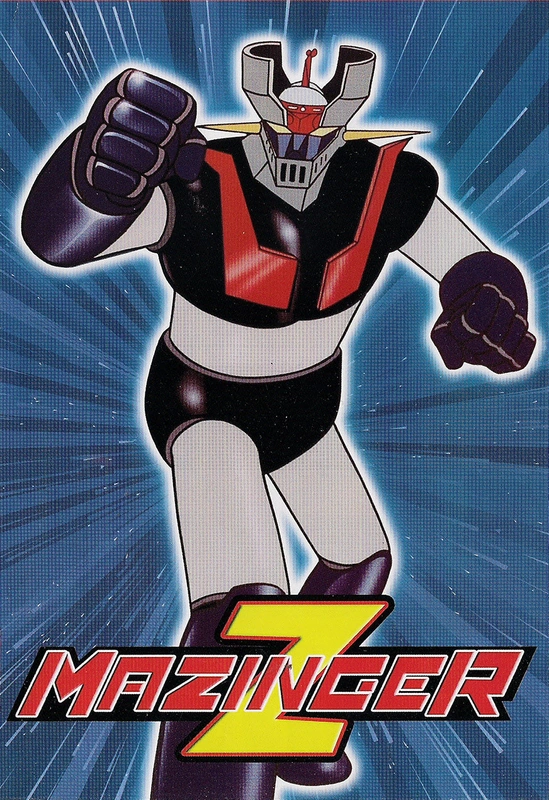
The animated series would eventually be re-edited and renamed for American audiences in 1985, going by the name Tranzor Z. Like UFO Robot Grendizer, Mazinger Z also became part of the Shogun Warriors toyline and comic book series from Mattel in the United States. And much like Grendizer, Mazinger Z got a name change to “Great Mazinga” for American media.
Mazinger Z was the genesis of many concepts that have since become signature tropes of the Super Robot genre, most notably the inclusion of a human sidekick who pilots the robot. In this case, a young man by the name of Koji Kabuto controls Mazinger Z from the crown on top of the robot’s head
But the fact that, even here in 2026, I still have to explain what Mazinger Z is, should give you some idea of how obscure this show would have been to the average American adult in 1987. I’m sure there was a conversation at MSGB over what to call this kiddie ride and it probably went something like this:
“Eh, I don’t know, Earl. Just call it “Star Wars” or something. The kids’ll love it.”
In all my research, I couldn’t find a better photo of this ride. Heck, I couldn’t even find another reference to this ride (and very few references to MSGB/Kiddyland) in the back catalogs of RePlay or Play Meter. So, I don’t know if it didn’t sell well and was pulled, maybe Lucasfilm caught wind and it underwent a name change, or if MSGB/Kiddyland didn’t last long in the industry, but this “Star Wars” ride seems to have disappeared into history.
Big Robot, Flying Robot
Founded in 1935, Togo was the leading manufacturer of Japanese amusement park rides for decades. They primarily designed and built roller coasters, but also dabbled in other attractions for theme parks, like carousels, dark rides, arcade games, and, yes, kiddie rides. Their most famous contribution to the industry is probably Whac-A-Mole, invented in 1975.
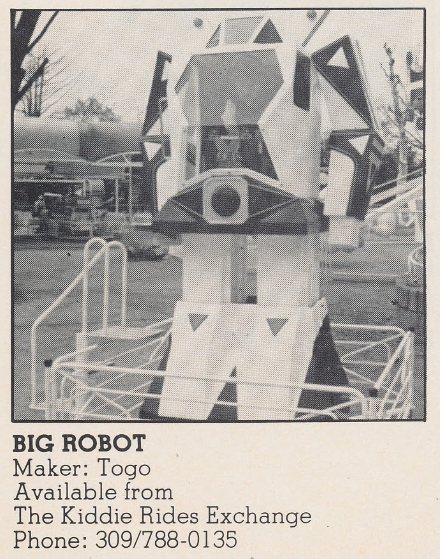
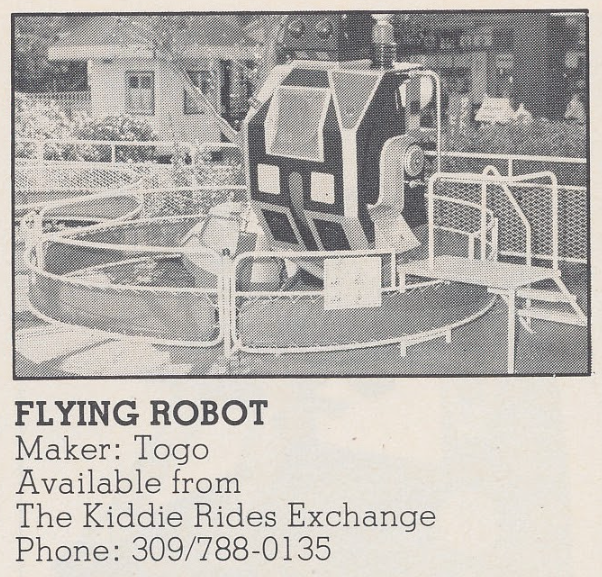
The only additional information I can find for either of their listings in this issue of RePlay – Big Robot and Flying Robot – is a single sales flyer for sale on eBay.
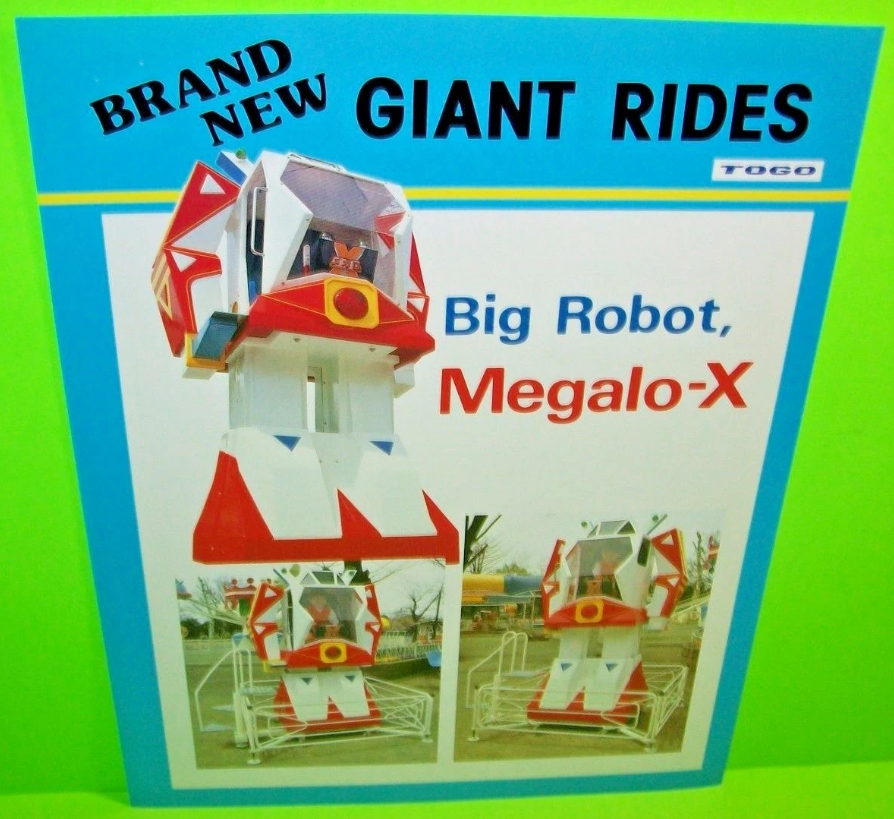
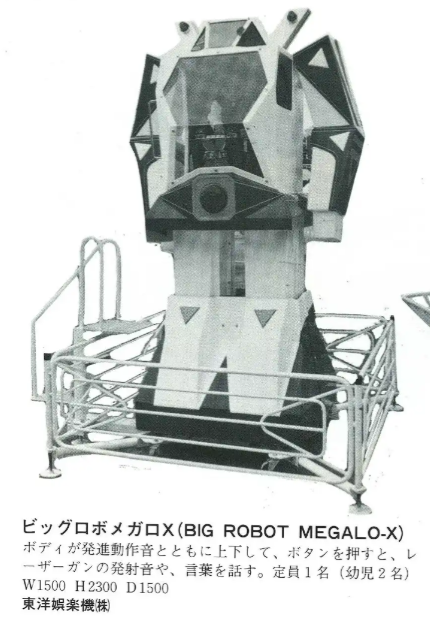
To clear up any confusion between the RePlay listing and the sales flyer, according to a Japanese amusement park equipment catalog from 1983, the official name of the ride is “Big Robot, Megalo-X”.
It appears that the ride consists of a kid walking up the staircase to the back of the robot, climbing inside the torso, and then using a lever to make the torso go up and down on its legs. There are probably some buttons inside that trigger sound effects, too. Fairly simple, but pretending you’re piloting a mech when you’re six years old would be a pretty awesome experience.
Meanwhile, the Flying Robot looks like a carousel, but with only one enclosed carriage made up to look like a robot. It’s kind of hard to see in this picture, but there is a robot head on top of the machine. I imagine the kids would climb inside, probably drop in their coin and hit a button, sending the carriage revolving around the central axis. I guess it’s sort of a kiddie version of one of those G-Force training pods you see in old military films where test pilots get spun around until they pass out. I’d love to see a sales flyer for this thing, because the fuzzy black-and-white photo in RePlay is pretty hard to make out. But I would assume it also had a bold red, blue, yellow, and white design like it’s cooler cousin, Megalo-X.
In 2000, Togo was hit with a lawsuit from Knott’s Berry Farms over the $6.2-million rollercoaster, Windjammer Surf Races. The Togo-designed and built coaster opened in 1997, but was plagued with breakdowns, and as a result, was barely ever running. The park spent an additional $2 million on repairs before finally closing the ride for good in 2000. A $17-million lawsuit was filed in which Knott’s Berry Farms alleged that the coaster was dangerous and had serious design flaws. The case lingered in litigation until the suit was dismissed in 2003, but that was too late for Togo, whose reputation was ruined, forcing them to file for bankruptcy in 2001.
Now wasn’t that fun? Like I said before, this was probably one of the most enjoyable deep dives I done for RePlay ReView, simply because these wonderful machines have such an interesting history. While kiddie rides are still being produced today, it’s an industry on the ropes. According to a quick Google search, there’s really only one stand-alone kiddie ride company left in America, Kiddie Rides USA. There are still companies making kiddie rides in other parts of the world, like the Fabbri Group in Italy, Sinorides in China, and Falgas, now headquartered in Germany (sadly, they no longer make El Coche Fantastico), but the number of companies is dwindling. Soon, these rides probably be gone just like the many shopping mall food courts that they once called home.
Did you have a favorite kiddie ride growing up?